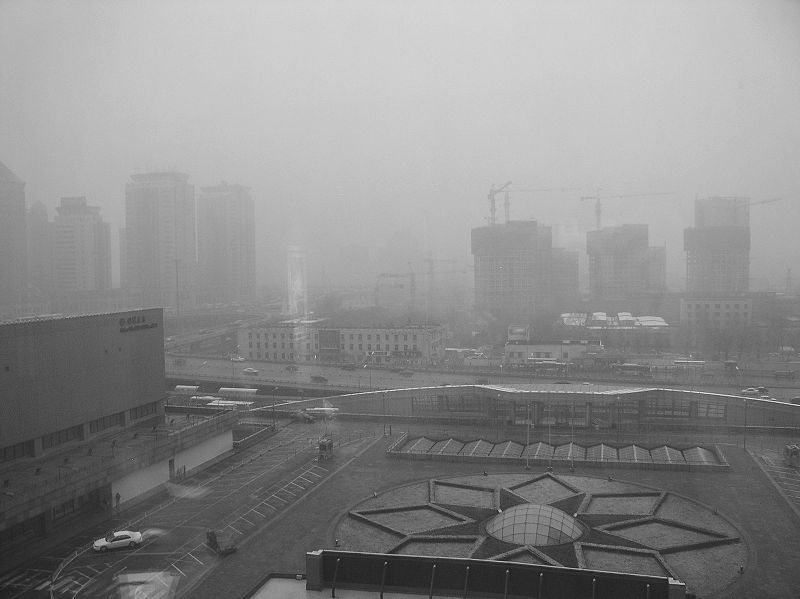
In EcoNoticiario #8: In Spain: protests against offshore wind power, and “streamlining” the review process for Environmental Impact Statements. Brazil to help Costa Rica with biofuels. A new study shows that Chile could produce 40% of its power with renewables by 2025. A Colombian editorial on air pollution and the Olympic Games in Beijing and oil-smeared penguins, sea lions and sea birds on the Uruguayan coast.

Today’s Spanish words:

Declaración de impacto ambiental–Environmental Impact Statement

energía renovable–renewable energy

aerogenerador–wind turbine

biocombustible–biofuel

lobo marino–sea lion

Spain

Danish offshore wind farm

Offshore wind farm in Denmark

Offshore Wind Power Generates a Storm of Protests

Even the cleanest energy leads to controversy. This time it has broke out in Cadiz with echos in Galicia and Tarragona because of the 31 offshore wind farms planned for 2012. They will produce 2,800 megawatts, the equivalent of 3 nuclear power plants.

But no town wants to see the silhouette of these giants from their shores. There is fear also of the impact on beaches, birds and fishing. The tuna fisherman worry that their prey will leave. Environmentalists–from Greenpeace and Ecologistas in Acción to the Spanish Ornithological Society (SEO) have raised many doubts and demand detailed studies in order to avoid committing any further assaults on nature.

But the wind power companies say the time is right:

Firms like Acciona, Capital Energy, Iberdrola and Enerfin have spent three to five years developing the technology adapted to each area. According to the CEO of Capital Energy, Carlos Cuadros, “The technoloy is now mature and we are ready to fix the windmills to the seabed and transport the electricity to shore. The first wind farm could be built in four or five years.

The only task remaining is to determine which areas are to be built in and which declared off limits. This will be done via the “Spanish Coast Strategic Environmental Study”. Meanwhile the opposition is preparing its response.

Opposition has been expressed by the three city councils of the area: Barbate, Conil y Vejer, the Fishermen’s Guild, business associations and the local branches of the CCOO and UGT trade unions and the neighborhood associations.

The conflict of interests has gotten to the point that [Capital Energy] met with Ecologistas en Acción to “show them that the fishermen are much harder on nature than the windmills themselves, relates Carlos Arribas, of Ecologistas en Acción. “If the fishermen are opposed to the windmills it’s because they will keep them from trawling, which is illegal, he observed.

The experience of countries such Denmark, which installed it’s first offshore wind farm in 1991 and which now has six in the North Sea, will help to foresee what the real risks are. “What has happened there is that artificial islands of life have been created around the windmill’s pylons”, explains Heikki Willstedt, Expert on Energy and Climate Change y for WWF/ Adena. “They are places where one cannot fish and the animals take refuge there.” Even so, Wellstedt believes that it is necessary to do a prior study in each zone to determine how it will be affected. “For example , bluefin tuna –one of the species fished for in Spain–is very sensitive to current dynamics, which could be changed by the new structures.

If all goes according to plan, construction work on the first offshore wind turbines in Spain could begin in 2010.

El País, Madrid August 8, 2008

Economic hard times are always a threat to the environment regardless of the political bent of the party in power. In Spain, governmental fears about declining construction (the basis of the recent Spanish economic boom just as in the US) has led to a proposal to weaken Environmental Impact Statements.

Government to Speed Up Environmental Impact Statements

The Government wants to speed up Environmental Impact Statements in order to avoid putting the breaks on infrastructure investments. Environment Minister, Elena Espinosa, announced that the proposal, which will be presented to the cabinet tomorrow, will be done without diluting environmental standards. Environmentalists have criticized the Executive branch’s proposed measures to alleviate the economic crisis as “misguided”.

The Minister has declared that the proposal will have an enormous economic impact as it will impact nearly all the the nation’s infrastructure projects and important industrial investments. “Environmental standards will not be lowered,” she emphasized. But she added that the main goal is to speed up the process as much as possible in order to avoid slowing down investment, given that they now “take a long time”.

Greenpeace España issued a statement saying that “the measure will make the environment the latest victim of the economic crisis”, while Ecologistas en Acción (Environmentalists in Action) declared: “The Government is clearly showing its support for unsustainable economy by approving measures that promote growth at the expense of the environment”.

El País, Madrid August 13, 2008

Mexico

Renewable Energy Could Supply 40% of Chilean Demand by 2025

By 2025, renewable forms of energy could satisfy 40 percent of the electrical demand of Chile’s Central Interconnected System (SIC), which supplies 70% of the country, according to a study released yesterday by the Universities of Chile and Federico Santa María.

Renewable energy could supply by that time some 40,000 gigawatt hours (GWh), a number close to the 41,464 GWh of demand that the National Energy Commission projects for all of 2008, according to the study: Potential contribution of non-conventional forms of renewable energy and energy efficiency to the the electrical grid from 2008-2025.

Nevertheless, by 2025 renewable energy production will cover only 40% of demand due to growth in consumption, which in that year will reach around 106,000 GWH, the report states.

Energy efficiency measures could contribute an additional 7,400 megawatts of power in 2025 in a country, 65% of whose power is hydroelectric, and which lacks the deposits of petroleum and natural gas that abound in other regions of South America.

According to Jorge Pontt, one of the study’s authors: “If timely measures had been adopted a few years ago to bring forms of renewable energy online, today we would not be paying such high prices.”

El Universal, Mexico City, August 8, 2008

Costa Rica

Lula Promises Help in Producing Biofuels

Yesterday, Brazilian president, Luiz Inácio Lula da Silva, promised Costa Rica technical assistance and technological support for the production of biofuels.

Sugarcane field

The assistance will be provided by representatives of Embrapa, a well-know Brazilian government company specializing in agricultural research.

Lula da Silva declared that the country meets the requirements to lead the “Central American biofuel revolution. He emphasized the country’s emphasis on environmental protection and its long tradition in growing sugar cane.

For his part, [Costa Rican president, Oscar] Arias, said last night that President Lula had told him that they are designing very tiny plants with a very advanced technology. “The idea is to produce biofuels using sugar cane. In the north and south of the country we could really help out small farmers by adopting the use of these plants, he explained.

La Nación, San Jose July 31, 2008

Colombia

South American sea lions

Petroleum-covered Penguins Arriving on the Uruguayan Coast

Besides these birds which travel from the south of Argentina to Brazil, since June more than 200 sea birds, sea lions and turtles have died, according to a member of S.O.S. Fauna Rescate Marino (S.O.S. Marine Fauna Rescue).

Although it is unclear, the worst moment seems to have been on June 4th when the Greek cargo ship Syros collided with the cargo ship Sea Bird, flying the Maltese flag, at anchor in the Río de la Plata about 20 kilometers from Mondtevideo, causing a oil spill from its damaged tanks and a black stain approximately 20 kilometers long, according to official reports..

It is assumed that much of the fuel is spilled when deliveries are made at sea, but there is no official confirmation of this.

”This cannot be seen as a normal occurrence that takes place every year during the penguins migration. It would be appropriate for the three nations involved, Argentina, Brazil and Uruguay to admit what is going on and to take possible protective measures, declared Richard Tessore of the marine wildlife rescue organization to AP.

”In any case,”, said Tessore, “oil-covered penguins are continuing to arrive right now and in certain areas there are oil slicks”.

El Tiempo, Bogota, August 14, 2008

Although I usually only post news reports specifically related to environmental questions in the Hispanic world, I thought readers of EcoNoticiario might find this editorial from Bogota’s El Tiempo on the environment and the Olympics in Beijing of interest.

90% of Cars Could Be Parked

Environmentally speaking, China looks like one of those indifferent students who wants to pass all of their clases, but only by acing the final exam.

Acccording to the UN, during the last decade it has consitently been the number two polluter of the planet’s climate emitting 6.046 [billion] tons of carbon dioxide. That is why, with the Olympic Games about to begin, its leaders are “racing” to make sure that the world’s athletes neither feel it nor notice it. First, they tried to staunch the “the wound” with damp cloths and then they built ecological stage sets. For example, the Olympic Village is lighted with solar panels and recycles rain water.

But just as the sun cannot be covered with a finger, the air pollution built up over years, combined with the humidity and the scarce seasonal wind has become a danger. That is why the authorities, in order to keep the stadiums from being covered again with a greyish toxic fog such as happened 8 days causing 3,600 athletes to go to South Korea to train, last Thursday suggested that 90% of the 3 million cars that circulate in Beijing might have to stay off the road.

Since July 20th the Chinese had been applying the more moderate “pico y placa” [Literally “rush hour and license plate”. Restrictions on vehicular traffic during rush hour according to the final number of a vehicles license plate introduced by Bogota Mayor Antanas Mockus JR] but this is an extreme solution that could go into effect as soon as the Olympic torch is lit. pero esta es una solución extrema que podría comenzar al mismo tiempo que se encienda la llama olímpica. The closure of cement factories has also been ordered if they fail to reduce the emissions of polluting gaes by 30 percent. 30 por ciento de las emisiones de gases contaminantes.

But the fear is that it will not be enough and so they have an arsenal of silver iodide rockets, which will be fired into the clouds to make the rains come and cleanse the air. All to make sure that during the 17 days of competition at least, Beijing passes the test and the world sees the cleanest air in China.

El Tiempo, Bogota August 3, 2008

[All translations by JohnnyRook]

Crossposted at Daily Kos

Posted by: JohnnyRook | August 13, 2008

Center of “Dust Bowl” Hit by Worst Drought Since 1921

n the first chapter of his National-Book-Award winning The Worst Hard Time: The Untold Story of Those Who Survived the Great American Dust Bowl, Timothy Egan describes Bam White and his family’s journey in 1926 through Cimarron County, Oklahoma on their way to Texas.

Through, No Man’s Land, the family wheeled past fields that just been turned, the grass upside down. People in sputtering cars roared by honking, hooting at the cowboy family in the horse-drawn wagon, churning up dust in their faces. The children kept asking if they were getting any closer to Texas and if it would look different from this long strip of Oklahoma. They seldom saw a tree in Cimarron County. There wasn’t even grass for the horse team; the sod that hadn’t been turned was frozen and brown. Windmills broke the plain, next to dugouts and sod houses and still-forming villages. Resting for a long spell at midday, the children played around a buffalo wallow, the ground mashed. Cimarron is a Mexican hybrid word, descended from the Apache who spent many nights in these same buffalo wallows. It means “wanderer”.[pp. 14-15]

Dallas SD 1936

Dallas, South Dakota, 1936

Were he alive today, Bam White would have no difficulty in recognizing the physical landscape of Cimarron County, which once again finds itself locked in the tenacious grip of drought. According to staff climatologist Gary McManus of the Oklahoma Climatological Survey (OCS):

“The area has been in and out of drought since the start of the decade. Mostly in,” McManus said. “But fall of last year was when it really started to get bad. In some places, this year has been as dry or even drier than the Dust Bowl.” As of early August, the Oklahoma panhandle was experiencing its driest year (previous 365 days) since 1921, according to OCS calculations. Through July, year-to-date precipitation in Boise City, Cimarron’s County Seat, was only about 4.8 inches, barely half of average and drier than some years in the 1930s, the height of the Dust Bowl.

Drought Map from NASA Earth Observatory

Map: NASA Earth Observatory

On June 19, the U.S. Drought Monitor applied its most severe drought rating: “D4–Exceptional” to Cimarron and Texas Counties.

This, despite the fact that local farmers, drawing on the lessons of the 1930’s, have changed the way the farm. Cherrie Brown, USDA-Natural Resource Conservation Service district conservationist from Boise (rhymes with voice) City in Cimarron County explains:

“The people around here learned their lessons in the Dust Bowl and the drought of the 50s,” Brown says. “They know it can get bad and they take care of the land year in and year out, so when a drought does hit, it helps protect their resources a little more.”

“Nearly everyone in the farming community around here has a conservation plan and tries very hard to follow those plans,” she adds.

But even the best conservation efforts can’t make it rain. Brown says soil tests show no moisture four inches down into the ground. In fact there is no subsoil moisture found as deep as six feet. Since the drought began in January 2007, many windmills have gone dry; others have had to be lowered and reset.

“The irrigated crops aren’t making it because although the farmers have watered and watered, the high winds and heat are so excessive, the water can’t keep up with the evaporation rate,” Brown explains. “Then if the plants do come up, wind erosion cuts them off and kills the crop.” [emphasis-JR]

Cimarron County Hardpan from NASA Earth Observatory

Cimarron County, Oklahoma, summer 2008 Photo: NASA Earth Observatory

Kiley Whited, the Natural Resources Conservation Service’s Rangeland Management Specialist for Cimarron County, says the situation on the area’s rangelands may be even worse. On the prairies that once sustained America bison by the millions, even the buffalo grass, whose fibrous root system helps hold the top soil in place, is dying or has gone dormant unusually early. “Buffalo grass is the most resilient of the native grasses to drought and grazing,” says Whited. “To see it wilting and dying is scary.” Because the vegetation has the additional pressure of grazing, it can take longer to recover from drought.

In order to help ranchers (but not farmers since only grazing has been approved) survive the USDA has allowed some of them to graze their cattle on lands belonging to the Conservation Reserve Program (CRP), which makes up 30% of the agricultural land in Cimarron County. The CRP is designed to protect land that is susceptible to environmental damage. Farmers are encouraged to:

…convert highly erodible cropland or other environmentally sensitive acreage to vegetative cover, such as tame or native grasses, wildlife plantings, trees, filterstrips, or riparian buffers. Farmers receive an annual rental payment for the term of the multi-year contract.

Although Farmers and ranchers are paid to keep the land out of production, in the case of a major emergency such as the current drought the land can be temporarily put back into use, which is what the USDA has done.

Unfortunately, it did so without completing an environmental impact statement (surprise, surprise), which led to a lawsuit by the National Wildlife Federation. A Federal District Court Judge in Seattle has given approval for the program to go ahead this year with the stipulation, among others, that in any future crisis, an EIS be completed before permission is give to graze the land, which, given how long it takes to complete an EIS, makes it unlikely any future permission could be granted quickly enough to help the ranchers.

The biggest irony in all of this of course is that in a drought, which has already ruined lands deemed more sustainable, the most vulnerable land is now being turned to grazing. What will be the consequences for these sensitive lands and the entire area if the drought continues for several years?

Not surprisingly, I have not encountered any reference to Climaticide in the reporting on the drought. Yet, as Sir John Houghton, Co-Chair of the Intergovernmental Panel on Climate Change’s Scientific Assessment Committee has written concerning “…the likelihood of drought in regions where the average summer rainfall falls by perhaps twenty per cent…”:

The likely result of such a drop in rainfall is not that the number of rainy days will remain the same, with less rain falling each time; it is more likely that there will be substantially fewer rainy days and considerably more chance of prolonged periods of no rainfall at all. In other words much more likelihood of drought. Further, the higher temperatures will will lead to increased evaporation reducing the amount of moisture available at the surface–thus adding to the drought conditions. The proportional increase in the likelihood of drought is much greater than the proportional decrease in average rainfall. [Global Warming: The Complete Briefing pp. 130-131]

These words which sound like an eyewitness account of the current situation in Cimarron County were written well over a decade ago.

Some of the farmers in Cimarron County have survived because they are irrigated. Yet the future of irrigation in the area does not look promising. To once again quote Timothy Egan:

Only a handful of family farmers still work the homesteads of No Man’s Land and the Texas Panhandle. To keep agribusiness going, a vast infrastructure of pumps and pipes reaches deep into the Ogallala Aquifer, the nations biggest source of underground freshwater, drawing the water down eight times faster than nature can refill it. The aquifer is a sponge stretching from South Dakota to Texas, which filled up with glaciers melted about 15,000 years ago. It provides almost 30 percent of the irrigation water in the United States. With this water, farmers in Texas were able to dramatically increase production of cotton, which no longer has an American market. So cotton growers, siphoning from the Ogallala, get three billion dollars a year in taxpayer money for fiber that is shipped to China, where it is used to make cheap clothing sold back to American chain retail stores like Wal-Mart. The aquifer is declining at a rate of 1.1 million acre feet a day–that is a a million acres, filled to a depth of one foot with water. At present rates of use, it will dry up, perhaps within a hundred years. In parts of the Texas panhandle, hydrologists say, the water will be gone in 2010. [Worst Hard Times pp. 310-311]

One might be excused for wondering whether anyone other than the spirits of Apache warriors will wander the parched lands of Cimarron County a couple of decades from now.

Crossposted at Daily Kos

Posted by: billlaurelmd | August 13, 2008

North Pole Today, 10 August 2008

Thanks to BilllaurelMD who has agreed to crosspost his weekly update on Arctic sea ice here at Climaticide Chronicles. [JR]

During the past week, the Arctic sea ice melt has continued, but at an accelerated pace, as covered by Kossack, JohnnyRook, in this diary. In that post, a National Sea Ice Data Center (NSIDC) news release was mentioned; it was titled “Race between waning sunlight and thin ice”. More on that after the jump.

Before we talk about the changes from 3 August 2008, here’s today’s webcam view from the North Pole, from 13:59 and some seconds universal time (UT) today, 10 August 2008.
00 Universal Time 10 August 2008

The Arctic Sea Ice Concentration graphic for today appears below.

1979-2000 arctic sea ice extent climo, 2007 and 2008 melt seasons; May 1-Sept 30
The rapid loss of sea ice apparent this week has at least temporarily slowed down to some extent, though it’s clearly faster than normal.

“Race between waning sunlight and thin ice”

What was the NSIDC talking about? Basically, they’re referring to the decreasing solar angle above the horizon as the sun slowly descends as it circles in the sky toward its long twilight at the North Pole. As this is happening of course, the South Pole awaits the long dawn; these both come at the autumnal equinox, September 22 at 21:29 UT this year.

Surface Energy Balance and Albedo

The decreasing angle of the sun means the same amount of solar energy is spread out over a larger area, leaving less per unit area available for, say, melting some ice. Depending on the condition of the surface (and the resulting albedo, that is, the ratio of solar energy striking the surface absorbed to that *reflected* to space) and the amount of cloudiness (which radiates energy back down to the surface based on *its* temperature), the net energy at the surface of the North Pole may go negative (and the surface begin cooling) *before* the sun sets (the earth emits infrared radiation at a rate based on the surface temperature to the 4th power. NOTE: Incoming energy also is used for melting ice and snow, evaporation of water from liquid and/or ice surfaces (known as sublimation), sensible heating of the water and/or ice (that is, changing their temperature), and through turbulent eddy transfer, heating the air above the surface.

The net cooling begins earlier if there is ice and snow at the surface (lots of solar radiation being reflected away rather than absorbed), rather than large areas of water absorbing almost all of what solar energy exists. This includes melt ponds like the one in the web cam picture above.

Also, as we know, thin ice needs less energy to melt; and water rather than ice and snow at the surface absorbs more solar radiation, increasing the amount of energy available. The positive feedback that results from reduced sea ice volume (not just reduced area, but reduced area *and* thickness) becomes obvious.

This week’s sea ice concentrations compared to last week and last year

The first row gives today’s sea ice concentrations for this year and last year; the bottom row gives last week’s data for the same years. Again there are large areas of relatively low concentration, and the areas of high concentrations of sea ice (say 80% or more) has decreased considerably. At least qualitatively, the area covered with high concentrations looks to be less than in 2007 at this time.

8/10/2008 sea ice extent sea ice concentration 8/10/2007 sea ice extent
Photobucket color legend for sea ice concentration Northern Hemisphere sea ice concentration, 10 August 2007
8/03/08 sea ice extent 8/03/07 sea ice extent
sea ice concentration, 8/03/08 same color code as above sea ice analysis 8/03/08

Concentrations of *loose* sea ice (which is what we find at this time of year) depend on winds as well as the amount of solar energy available and the ambient temperature. All else being equal, converging winds will increase sea ice concentrations, diverging winds decrease them.

Comparison to long term 1953-1991 climatology

The climatology for sea ice concentration for 10 August is shown below, for the period from 1953-1991. Ice data before 1972 is less available (1972 onward is from satellite, and is very good after 1979). The color code for concentration is the same as above. Note that this climatology is earlier than for the areal sea ice coverage (which is from 1979-2000), so it’s not directly comparable, though evidence seems to show that ice coverage didn’t change much from the 1950s through the 1970s.

Northern Hemisphere Sea Ice climatology, 10 August

Areas that are dark blue in the climatology graphic can be assumed to have never been free of ice in the 1953-1991 period. It’s clear than many areas free of ice now had never been free of ice during that period, including much of the area north of AK and some of the channels in the Arctic Archipelago (north of Canada, wherein lies the so-called Northwest Passage, which opened up last year).

Areas to watch for sea ice loss

If you go back to previous weeks, the losses of sea ice cover (15% or greater concentration per 25 km2) seem to at least loosely correspond with areas that previously had relatively low concentrations. Using that as a rule of thumb for now, the areas highlighted in the graphic below should be watched for rapid decreases.

Photobucket

Posted by: JohnnyRook | August 12, 2008

Bush’s Appalachian War: Bombing Ancient Mountains

The following post is by guest contributor Patriot Daily News Clearinghouse. An earlier version appeared on Daily Kos on October 27, 2007. The issues that it brings up are no less relevant now than they were then. (Check out this link for an update on the grassroots movement to pass the Clean Water Protection Act. As James Hansen has pointed out we must stop our use of coal if we are to avoid catastrophic climate tipping points.

Phase out of coal use except where the carbon is captured and stored below ground is the primary requirement for solving global warming.

What Patriot Daily News Clearinghouse makes quite plain, is that there is no such thing as “clean coal” from an overall environmental point of view. While carbon capture and sequestration, supposing it can be made to work, would be a big step toward solving coal’s greenhouse gas problem (Dr. Hansen’s focus) it does nothing to deal with the environmental and human cost of mountaintop removal. The burning of coal, a primitive 19th century technology, has no place in a modern portfolio of power generated from wind, solar, geothermal, etc. [JR]

Bush cites his “global war on terror” and the need for energy independence as reasons to legalize the killing of mountains from a range that has lived for millions of years.  There is no way to bring back the over 450 mountaintops that have been razed solely to permit profitable coal mining for his buddies.  Instead of pursuing a clean energy policy, Bush has declared war on Appalachia.  Many Americans are not aware that our self-proclaimed patriotic warrior who loves to preach adherence to religious doctrine is killing our “purple mountain majesties” that God has “shed His grace on” for the benefit of all. This is a war, complete with Bush authorizing mining companies to occupy Appalachia, literally bomb away the mountain summits and kill not just mountains and streams, but people, culture, environmental habitat and species.

During 1985-2001, “approximately 800 square miles of mountains were leveled.”  What would this look like in your state? Well, some perspective is provided by looking at the 10,000 acre Hobet MTR Complex in West Virginia which was superimposed over 38 US cities to show how much land would be destroyed.

This is how it would look in Portland, Oregon:

San Francisco:

NYC:

Every step of mountaintop removal (MTR) has dire consequences for people, culture and environment.

1. Clear-Cutting Forests

Before mining companies can get their greedy little paws on the black gold, they have to clear-cut native hardwood forests and remove all of the topsoil and vegetation from the mountaintop.  The mining companies may sell the trees to eager lumber companies, or they may simply burn the trees or dump the trees in nearby valleys.

The Southern Appalachian Mountains are an “ancient, topographically diverse” range and it is this antiquity and topographic diversity that provided high levels of biodiversity “unparalleled in the temperate zone.”  It is a confluence of factors — such as age, north-south range alignment which allows species to easily migrate, elevation gradients of gorges and summits that allow temperature changes to protect species —  that made the mountains one of the “richest temperate areas” and one of our top biodiversity hotspots:

When the mining companies kill “America’s own little miniature rain forest,” they are also killing the “world’s most diverse temperate hardwood forest” that functions as the “carbon sinks and lungs of the East Coast:”

According to a rough estimate by West Virginia University bio-geochemist William Peterjohn, the deforestation could add as much as 138 million tons of carbon dioxide into the atmosphere — and that’s not even counting the even-larger CO2 emissions from burning the coal.

The EPA reported in 2003 that 7%  or 400,000 acres of “rich and diverse temperate forest” had been killed during 1985-2001. That same year another 20, 579 acres were approved for strip mining, which is triple the previous year and is the most new acreage approved by our government for stripping since 1989. In 2006, it was estimated that another 100,000 acres had been killed since that EPA report.  

An EPA report states that if there are no restrictions, “2,200 square miles of Appalachian forests — an area twice the size of Rhode Island— will be eliminated by 2012.”

Another direct impact of stripping away trees, vegetation and topsoil from the mountain top is to increase surface runoff which increases floods.  The conditions for flooding are enhanced by the filling of valleys with the rock and soil that used to comprise the mountaintop as this fill now blocks natural drainage patterns.

Some small towns have been hit by 5 major floods in 18 months after not experiencing a major flood since 1957.

In Chopping Block Hollow, “three so-called hundred-year floods happened in 10 days” in 2002.

2.  Blasting 800-1,000 Feet Of Mountaintop Away!

After the native hardwood forests are killed, the mining companies use explosives to now kill the mountaintop on Appalachians formed millions of years ago by blowing apart as much as 800-1,000 feet of the mountaintop.  Layer after layer of rocks are bombed until the mountaintop is gone.

Thousands of bombs go off daily in Appalachia that can be 10 to 100 times (pdf file) the force of the blast that killed 168 at Oklahoma City Federal Building.

It is claimed that “every four days …more explosives are used against Appalachia’s hills than were used by the US military in the entire Afghanistan bombing campaign (pdf file). Every day in Appalachia, the blasting is the equivalent of 1,000 Oklahoma City bombings.”

The EPA recognized that the “dynamite blasts needed to splinter rock strata are so strong [that] they crack the foundations and walls of houses.”  The blasts are also cracking the foundations of water wells and the land.

The blasting also creates clouds of rock and coal dust outdoors and in homes.

There is no published research into pollution caused by explosive residues, but “when the explosives go off, you can smell and see the pollution coming down, the ammonium nitrate.”

One morning a mom heard her 12-year-old daughter, who was playing in the mountain valley where her family had lived for hundreds of years, scream for help:

Gunnoe rushed outside to find Chrystal coming towards her. Chrystal was coughing and struggling to breath, running from a strange-looking cloud that was moving down the valley and headed towards their house. Gunnoe would later learn the strange cloud came from something known as a “slow burning blast” — an explosion set at the coal mine above her home that failed to ignite and instead burned slowly, releasing a wet toxic cloud of nitrogen oxide and carbon dioxide.

In the weeks following, Chrystal suffered from a bronchial infection, a consistent cough, nose bleeds and bouts of painful breathing. Her mother, who was also exposed, “had sores on the inside of [her] nose,” she said. “First they take our land, then the water, now the air.”

The blasting also causes“fly rock,” more “aptly named fly boulder,” that can “rain off mountains“, endangering resident’s lives and homes” as blasting can send “boulders flying hundreds of yards” into roads and homes.”  This is the mining “army” version of shrapnel.

The EPA reports that more than 800 square miles of mountains have been destroyed, which is “equal to a one-quarter mile wide swath of destruction from New York to San Francisco.”

3.  Digging Up Rock And Soil

After the bombs come the draglines, which are gigantic 2,000 ton, 20 story-high earth-moving machines that can scoop tons (pdf file) of “overburden” or “spoils”  – rock, soil and debris — so that mining companies can reach the seams of coal.  The scoops on the draglines can “hold 100,000 pounds, or as much weight as 40 Toyota Corollas.” While the mining companies call this “overburden” or “spoils,” this is the rock and soil that previously comprised the mountaintop (pdf file).

However, at this stage it is appropriate to call this rock and soil waste because it now also includes the toxic components of the chemicals used for blasting.

4.  Valley Fills Or Dumping Toxic Waste Into Valleys

The blasting blends together the rock and dirt from the former mountaintop with the blasting chemicals and debris, and this waste is dumped into valleys that are contiguous to the MTR site. The mining companies call this the creation of “valley fills,” which is simply filling the valleys with “millions of tons”  of the waste rock and dirt that may be hundreds of feet deep  depending on whether 500 or 1,000 vertical feet were chopped off the moutaintop. Large mines may be surrounded by several valley fills.  A “single fill may be over 1,000 feet wide and over a mile long (pdf file).”

Imagine a peaceful little stream flowing in the valley of the mountains with its lush habitat for aquatic and riparian habitat critters. All of a sudden tons of rocks, soil and mining debris are dumped on top of the stream, literally suffocating the stream and any life to death.

The CRS notes that valley fills are killing the streams and the aquatic and wildlife habitat (pdf file) supported by the streams, flow patterns are altered, increasing the number and severity of floods and degrading water quality:

Today the volume of a single stream fill can be as much as 250 million cubic yards. As a result, streams are eliminated, stream chemistry is harmed by pollutants in the mining overburden, and downstream aquatic life is impaired. From 1985 to 2001, an estimated 724 stream miles in West Virginia, Kentucky, and parts of Virginia and Tennessee were covered by valley fills and 1,200 miles of headwater streams were directly impacted by mountaintop mining activities.

During 1985-2001, 6,700 valley fills were approved for central Appalachia. The EPA estimated that during these 16 years, more than 1,200 miles of valley streams had been “impacted” by valley fills and more than 700 miles of streams had been killed, buried entirely.  All these figures are now outdated. But here’s a little perspective: Every 1,000 miles of streams impacted or killed by valley fills is a “greater distance than the length of the entire Ohio River.”

Notice that the EPA distinguished between streams that were buried alive and streams that were otherwise “impacted.”  Government studies show that streams not buried by mining waste “carry high levels of silt and toxic chemicals.” Federal studies “found substantially higher levels of selenium, a mineral that is toxic to fish in high doses — in rivers near the mines. The U.S. Fish and Wildlife Service estimated that as many as 244 species, including several that are endangered, were being affected by the loss of forest and aquatic habitats.”

A university study found that children were also “impacted” as they  “suffer from an alarmingly high rate of nausea, diarrhea, vomiting, and shortness of breath — symptoms of something called blue baby syndrome — that can all be traced back to sedimentation and dissolved minerals that have drained from mine sites into nearby streams. Long-term effects may include liver, kidney, and spleen failure, bone damage, and cancers of the digestive tract.”

But, that’s ok. A family whose well has been contaminated may be one of those families who now receive bottled water for drinking by the mining company.

Will the mining companies supply drinking water to America also? This region is also the headwaters of our drinking water supplies for many US cities.

Another “impact” is how the valley fills contribute to flooding. A study by federal regulators predicted that one valley fill “could increase peak runoff flow by as much as 42 percent.”

Our federal government issues permits (pdf file) for these valley fills, which are really valley kills.  In the past, the mining debris was placed at the headwaters of streams with intermittent flow. In recent years, the mining companies have moved to valley fills over any stream “because smaller upstream disposal sites are exhausted (pdf file) and because of the increase in mountaintop mining activity.” The poor mining companies argue that MTR simply “would not be economic or feasible (pdf file) there if producers were restricted from using valleys for the disposal of mining overburden.”  This is why Bush keeps changing regulations and laws to immunize mining companies so that they may legally kill our mountains, valleys and streams in the most profitable manner.

Another problem generated by MTR is the danger of landslides and rockslides from the mining work related to blasting and valley fills. In 2004, a bulldozer dislodged a 1,000 pound boulder from a MTR site, and it then rolled 200 feet down the mountain and crushed to death a sleeping 3 year-old child:

Communities live in fear of valley fills “tumbling down in landslides of unpredictable proportions. As one Kentucky attorney likes to put it: “A valley fill is a time bomb waiting to happen.”

5.   Coal Slurry Time

After killing the mountain, streams and species and some people from the “impacts” of blasting, digging and valley fills, we come to the part of the MTR process where the coal is exposed and removed, and then ready for a little processing treatment before loading onto trucks and trains to ship out.

The coal is washed and treated to remove debris and the blasting residues  and the excess toxic water and black, gooey goop from this process is called coal slurry or sludge, which the mining companies store in open impoundments.  The toxics (pdf file) come from those chemicals used in the processing treatment as well as the fine particles of coal that are in the goop.

According to the Sludge Safety Project, “sludge contains carcinogenic chemicals used to process coal. It also contains toxic heavy metals that are present in coal, such as arsenic, mercury, chromium, cadmium, boron, selenium, and nickel.” Bill Moyers noted that “it’s estimated there’s over one-hundred and ten billion gallons amassed in active West Virginia impoundments.” This toxic goop is stored in open pool impoundments located on top of the flattened mountains and in some cases, the goop is pumped into abandoned underground mines, which means the goop is being released into groundwater basins.

Last year, there were 500 sludge impoundments in Appalachia.

One problem is that the toxic slurry impoundments are held back with unreinforced earthen dams that have been breached, killing the people below and creating more environmental “impacts”:

Buffalo Creek Disaster 1972

In 1972, a coal slurry dam failed in Buffalo Creek valley, flooding the hollow with 132 million gallons of coal waste:  125 people were killed, 1,100 injured, 4,000 people rendered homeless and 16 communities destroyed as well as over 1,000 cars and trucks.

One eyewitness remembers:

“It started out just as a flood would, the water was coming over the bank, then with every succeeding second it came faster and faster. Then the water just rolled, you could see it rolling down the valley. A black wall of water…

“That flood took 10 to 15 minutes, and it was total black sludge water, about 130 million gallons of sludge. And it just moved houses. Like matchsticks they were just being moved. And cars, and we saw trees bend and railroad tracks wrapped around trees…

“Everyone (of the corpses) looked the same. They all looked black. Because it was all black sludge water. This was a sludge pond. This was water they used to wash the coal, then they put it in an earthen dam and over the years just kept building it up and backing it up…They were all black. Hair, nose, mouth. Some were stripped of their clothing, okay? It was horrible. It was a horrible thing for me to see.”

Big Sandy River Disaster 2000

The EPA called this one of the worst environmental disasters in the Southeast. More than 250 million gallons of toxic sludge breached the impoundment — or 25 times the amount of the oil spilled in the Exxon Valdez disaster — and poured into the Big Sandy River and reached the Ohio River 60 miles away. The sludge was laced with poisonous heavy metals (e.g., mercury, lead and arsenic).

At some places, the thick goop was 10 feet deep and in other places 70 yards wide “swallowing backyards, gardens and driveways and annihilating fish and other aquatic life.”  No people were killed. But, “20 miles (32 kilometers) of stream valley would be declared an aquatic dead zone” as “fish, snakes, turtles and other species” were smothered by the sludge. The State wildlife agency estimated that 1.6 million fish were smothered in the molasseslike substance while lawns were “buried up to 7 feet deep in sludge.”

The mining company blamed the disaster on a “sudden and unexpected” collapse of a wall between the impoundment and the mine shaft underneath, but federal and state mine safety records showed that the mining company knew from a similar spill from the same impoundment 6 years earlier that there was this danger.  

Winding Shoals Hollow 2002

During a thunderstorm, the rain-saturated valley fill separated and crashed into a sediment pond, which overflowed, sending a “tidal wave of sediment-laden water churning down Winding Shoals Hollow, destroying two homes, damaging about ten others and hurtling 8-10 vehicles downstream. No one was killed, though there were some narrow escapes.”

More homes destroyed:

Another community to clean-up:

Marshfork School: Disasters Lying In Wait

Throughout Appalachia there is the constant fear of another slurry impoundment disaster. For example, another impoundment houses 3 billion gallons of toxic slurry and an elementary school is located 400 yards downslope from this impoundment. The school is located between the coal silo and football field in the lower left of this photo.

Should this earthen dam breach, “there would be less than three minutes to evacuate the Marsh Fork Elementary School before the water reached 6 feet” and it is feared that the floodwaters would rise to 15 feet at the school.

Even without a slurry flood, every day students are sent home sick with “asthma problems, severe headaches, blisters in their mouths, constant runny noses, and nausea” which may be related to leaks from this impoundment or to the coal silo located so close to the school.

The community is demanding that government provide a new, safe school, but even civil disobedience and protests leave them with no redress.(Photo by Graham Boyle)

People who live near any of the hundreds of slurry impoundments suffer the  constant stress of knowing sludge floods could happen at any time.  Another slurry waste site  — the Brushy Fork slurry – houses 8 billion gallons of toxic sludge 3 miles upstream from the Whitesville community.

“What’s going to happen to all that water if the dam breaks or the basin collapses into an abandoned underground mine?” By some accounts, should the Brushy Fork impoundment ever fail, a wave of sludge 25 feet (7 meters) high could roll over Whitesville in no time flat.

6.  Reclamation

Once the mountains have been razed to denuded, flattened moonscapes, then comes the “reclamation” which the EPA says “may not occur for hundreds of years.” Truth is it will never happen.

The Congressional Research Service (CRS) admits that MTR precludes actual restoration (pdf file):

While federal law calls for excess spoil to be placed back in the mined areas — returning the lands to their approximate original contour (AOC) — that result ordinarily cannot be accomplished with mountaintop mining because broken rock takes up more volume than did the rock prior to mining and because there are stability concerns with the spoil pile.

If “stability concerns with the spoil pile” is a reason why razed mountaintops can not be reclaimed by returning the rocks and soil to the mountaintop, why is stability not a concern when these same rocks and soil are dumped into valleys?  This is one reason why our work to obtain more sponsors for the Water Protection Act is so important.

The mining companies assure us that they are “careful stewards of the land” and boast of the benefit of transforming mountains into flatlands:

“People have used these sites to build high schools and golf courses — they see it as an opportunity to stimulate the economy and create jobs,” said Gerard, the National Mining Association president. “Some of the sites are so beautifully reclaimed, many people can’t tell the difference.”

Yes, new golf courses (photo by Vivian Stockman):

Hey folks! It’s “economic development” on a Mingo County mountaintop removal site. That’s right, a golf course for the residents of one of the poorest counties in one of the poorest states in the nation. Don’t mind the silica-laden-dust floating in the air from that mountaintop removal blast over there. Don’t mind the treeless, sun-baking you’ll get on this course. Just shut up and golf.

The feds agreed and gave the mining companies a blanket exemption:

It was not the intent of Smackra, of course, to allow coal companies to walk away from their surface mines and leave them denuded. Stripped mountainsides, the law declared, must be restored to their “approximate original contour” and stabilized with grasses and shrubs, and, if possible, trees. But putting the entire top of a topped-off mountain back together again was an altogether different—and more expensive—matter. So mountaintop mines were given a blanket exemption from this requirement with the understanding that, in lieu of contoured restoration, the resulting plateau would be put to some beneficial public use.

MTR has turned our beautiful, national treasure of Appalachia into a war zone. This video shows the devastation:  The bombings of the mountains, the dumping of rocks and debris into valleys, the flooding that kills, repeated washing away of bridges, the toxic coal slurry impoundments located on top of flattened mountains, and ends with a very powerful google earth video memorial showing our flag waving over each of the over 450 mountains killed:

The coal mining companies rolled out the patriotism card by campaigning in 2004 that “increased coal production could even help win the war against terrorism.”

A Vietnam Veteran does not buy that homeland security baloney, … do you?

“I’ve been coming up through these mountains since I was 5 years old. Now the place looks like an asteroid hit,” Bo Webb, a retired businessman and Vietnam veteran, said of the 1,800-acre mountaintop mine above his house in central West Virginia’s Raleigh County. “A lot of us up here have fought for our country. To see what is happening now to our homes makes me so mad.”

There is an easy, safe, answer that would respect the people, culture and Appalachian environment:   Wind farms.

I think this diary provides a few good reasons why we should call, email or write lawmakers to sponsor the Water Protection Act.

As Devilstower says:

If you’ve already contacted your own congressperson, here are a few more you might consider calling today.  Dingell’s been so keen on obeying the auto industry at the cost of the environment, the least he can do is put his name on this bill.  And Russ Carnahan doesn’t have a miner in his district — but he does have the headquarters of three major mining companies.  Make him prove he values ordinary citizens over CEOs.

District Representative DC Office Dist Office
MI
1 Bart Stupak 202-225-4735 231-348-0657
13 Carolyn Kilpatrick 202-225-2261 313-965-9004
15 John Dingell 202-225-4071 313-278-2936
MN
1 Tim Walz 202-225-2472 507-388-2149
7 Collin Peterson 202-225-2165 218-847-5056
8 James Oberstar 202-225-6211 218-727-7474
MS
2 Bennie Thompson 202-225-5976 601-866-9003
4 Gene Taylor 202-225-5772 228-469-9235
MO
3 Russ Carnahan 202-225-2671 314-962-1523
4 Ike Skelton 202-225-2876 816-228-4242
5 Emanuel Cleaver 202-225-4535 816-842-4545

NOTE: A special thanks to Vivian Stockman of the Ohio Valley Environmental Coalition where she advocates on issues involving Mountaintop Removal, Coal Slurry and Coal Sludge as well as taking amazing photos and generously answering questions for newbies like me. Flyover courtesy SouthWings.org.

Photo sources:

Clear-cutting forests: Vivian Stockman

Blasting: iLoveMountains

Cracked Land: Appalachian Voices

Dragline:  Vivian Stockman

Slurry impoundment: Kent Kessinger

Big Sandy River Disaster: Appalachian Voices

Winding Shoals Hollow Disaster: Photos extracted by OVEC from video taken by Bob Gates

Marshfork: Vivian Stockman

Reclamation:  Vivian Stockman

Today’s news that we may set a new Arctic sea-ice melt record in 2008 is, along with a number of other recent stories, further indication that Climaticide is proceeding full speed ahead the Arctic.

Warming temperatures resulting from our continued emissions of greenhouse gases are causing sea ice to melt (at both poles) at ever faster rates, ice shelves to collapse, 30 degrees-above-average temperatures in areas of the Arctic, the potential migration of sea creatures from the Pacific to the Arctic and the Atlantic after a 3.5 million year hiatus, and creating a new area for global conflict as the Northwest Passage opens and polar nations scramble to lay claims for both strategic and economic reasons.

If you need to pull an all-nighter tonight, forget the caffeine. Just read on.

During the last week of July a 7 square kilometer piece of the Ward Hunt ice shelf, the largest ice shelf in the Arctic broke up into 3 pieces.

Scientists reacted with unusual bluntness:

“Canadian ice shelves have undergone substantial changes in the past six years, starting with the first break-up event on the Ward Hunt Ice Shelf, and the loss of the Ayles Ice Shelf,” said Dr. Luke Copland of the University of Ottawa. “These latest break-ups we are seeing have come after decades of warming and are irreversible,” said Dr. Derek Mueller of Trent University. [Science Daily]

Gary Stern, co-leader of an international research program on sea ice, said it’s the same story all around the Arctic.

Speaking from the Coast Guard icebreaker Amundsen in Canada’s north, Stern said He hadn’t seen any ice in weeks. Plans to set up an ice camp last February had to be abandoned when usually dependable ice didn’t form for the second year in a row, he said.

Nobody on the ship is surprised anymore,” Stern said. “We’ve been trying to get the word out for the longest time now that things are happening fast and they’re going to continue to happen fast.” [Associated Press]

A couple of days after the breakup at the Ward Hunt ice shelf, Canadian Park officials announced the evacuation of 21 tourists from Auyuittuq National Park on Baffin Island due to Climaticide related changes there:

Thawing permafrost, eroding lakeshores, a melting glacier and fears of flash floods at a national park on Baffin Island have forced the evacuation of 21 tourists and led officials to declare much of the wilderness reserve off-limits until geologists and ice experts can assess what appear to be the latest dramatic effects of climate change in Canada’s Arctic.

The 19,000-square-kilometre Auyuittuq National Park on the island’s northeast coast has recently experienced “record-breaking” warmth and substantial amounts of rain, Parks Canada spokeswoman Pauline Scott said Thursday.

“This summer’s events are beyond anything we’re used to,” Ms. Scott said from Iqaluit. “This is no doubt a result of climate change.” [National Post]

Auyuittuq National Park

MSNBC also quoted Ms. Scott:

“We’ve lost huge proportions of what was formerly the trail in the park. It’s disappeared — gone,” Scott said by phone from Iqaluit, capital of the Arctic territory of Nunavut.

Most visitors walk through the park — which is slightly smaller in area than Israel — starting from the southern edge, near the town of Pangnirtung.

The problems started last month with two weeks of record temperatures on Baffin Island that reached as high as 81 Fahrenheit, well above the July average of 54 F.

That, Scott said, triggered massive melting that sent “a huge pulse of water through the park,” washing away 37 miles of a trail used by hikers and destroying a bridge over a river that is otherwise impassable.

Meanwhile the melting of Arctic sea ice continues apace. Check out the weekly updates by DK blogger and climate scientist BilllaurelMD. As recently as ten days ago, scientists at the United States National Snow and Ice Data Center were expressing doubts about whether 2008’s sea ice melt would match the record-setting levels attained in 2007.

In today’s report however, the skepticism seems to be melting along with the ice. The melt rate has increased due to storms in the Chukchi and Beaufort Seas which took out large expanses of newer thin sea ice formed this past winter on the heals of last year’s thawing of thicker and older sea ice.

Once again, Canadian scientists are plain-spoken in their assessment of events:

Last year, 14 million square kilometres of Arctic Ocean ice shrank to just over four million between March and September. The minimum is typically reached in mid-September.

It’s now a “neck-and-neck race between 2007 and this year over the issue of ice loss,” Mark Serreze, a senior climate researcher at the U.S. ice data centre told Britian’s (sic) Guardian newspaper yesterday. “We thought Arctic ice cover might recover after last year’s unprecedented melting — and indeed the picture didn’t look too bad last month.”

But recent storms in the Beaufort region “triggered steep ice losses,” he said, “and it now looks as if it will be a very close call indeed whether 2007 or 2008 is the worst year on record for ice cover over the Arctic.”

The Canadian government’s chief observers of Arctic ice conditions are expressing amazement at the state of the Beaufort Sea.

“We’ve never seen any kind of opening like this in history,” senior ice forecaster Luc Desjardins said of the Beaufort’s exceptional loss of ice this summer. “It is not only record-setting, it’s unprecedented. It doesn’t resemble anything that we’ve observed before.” OttawaCitizen.com

That’s because nothing on this scale has likely happened for millions of years according to University of California marine ecologist Geerat Vermeij and California Academy of Sciences paleontologist Peter Roopnarine in an article to published today in the journal Science. Vermeij and Roopnarine are predicting the migration of marine creatures from the Pacific to the Arctic and Atlantic. Although their study focuses on mollusks because they are so well preserved in the fossil record, Roopnarine also noted that

warming “could definitely promote invasions by other aquatic species, fish included. I can’t be as certain of marine mammals and sea birds, but if food sources expand, then they will also likely expand their ranges.”

Churchill Polar bears

If you’re not intimidated by visions of migrating mollusks how about polar and grolar bears, which, because of the loss of their traditional hunting grounds, are already moving to new territory, as 5 scientists in northern Alaska discovered today.

And finally there is the news that that the Arctic is increasingly likely to become a target of geopolitical contention:

The great polar thaw has also prompted Canada, Russia, Denmark, the U.S. and Norway — the five nations with Arctic Ocean coastlines — to expedite efforts to claim oil-rich undersea territory and invest billions to enhance their military, scientific and economic presence in the far north.

Coast Guard

Last week, during a visit to Alaska, U.S. Coast Guard commander Admiral Thad Allen revealed U.S. plans to recast its foreign policy in the Arctic from a focus on scientific research to “sovereignty” and “security presence.” [OttawaCitizen.com]

For background information see this news article and my diary from last December. The irony in this new emphasis on geopolitics in the Arctic is that one of the factors causing governments to scramble to position themselves as advantageously as possible is the possibility of exploiting Arctic oil deposits that have been, until now, out of reach. Offshore drilling possibilities par excellence. Or, to put it another way, the consequences of Climaticide in the Arctic may provide us with the means to continue practicing Climaticide until it’s too late for us to do anything about it.

Are you wide awake yet?

[Hat Tip to desmogblog]

Crossposted at Daily Kos

Posted by: JohnnyRook | August 9, 2008

Shhh! Beijing’s polluted, but don’t tell anybody, OK?

The Daily Telegraph is reporting that the Chinese government has ordered a British research group associated with the European Space Agency to shut down it’s web site. Apparently, the British group was publishing data that differed from official Chinese government data.

At first [the web site] was freely accessible, but after earlier complaints by the Chinese authorities, it was restricted to users by password only.

But on Friday, the day of the opening ceremony, the quarter of Beijing in which the Olympic Green is situated was coloured green on the map, marking an air pollution index (API) of 101-150. The government’s safe limit is 100, and the city authorities’ figures put the API at 95.

The reason for the “green” colour was high levels of particulates, known as PM10. Again, while the online map gave a fail for the Olympic Green, the figures for the nearest monitoring station in Beijing showed a pass.

Later on Friday afternoon, subscribers to the website received an email saying the site would no longer be visible by password.

One of the things the Bush administration and the Chinese government have in common is their belief that if you can hide something it’s not real. Politics as solipsism.

View of Beijing January 20, 2008

Beijing, January 20, 2008

Welcome to the Beijing Olympics. Here are you’re rose-colored glasses. If you’re American, you probably already own a pair.

Homeland Security, arguably the most incompetent agency in the astonishingly incompetent Bush Administration, has announced that it wants to spend tens of million dollars fighting hurricanes. That’s right, HS, loser by a knockout against Hurricane Katrina, has staggered to it’s feet and declared that it wants a rematch, not just against another hurricane but against all hurricanes.

The project has been given an estimated price tag of around $64m (£32m) over six years. Scientists will first conduct tests using models and small scale experiments before the most promising idea is developed for large scale testing.

Among the plans is a scheme to seed hurricanes with microscopic particles of salt that have been released into a storm from an aircraft. Research has shown that such seeding can cause hurricanes to dump large quantities of rain over the sea before it reaches land. The rainfall also carries away the heat that powers the hurricane, weakening it.

Apparently fighting terrorism isn’t enough to satisfy the dreamers at HS, who now want to add geo-engineering to their resume.

HS Fema trailer

Do you thinks the folks who brought you this…

Typhoon Odessa

are capable of taking on this?

“Part of the reason the department is so dysfunctional is that it tries to do too many things,” says Clark Kent Ervin, the first inspector general of DHS. “Many people feel that the department should stick to counterterrorism efforts.”

Dr John Latham, a British researcher at the National Centre for Atmospheric Research in Colorado, has proposed spraying a fine mist of sea water into the clouds over the parts of the Atlantic Ocean where hurricanes form, to increase their brightness. This would mean more sunlight is reflected back into space, causing the sea to cool.

He said: “Even cooling the surface of the water by a couple of degrees will reduce the intensity of the storms and the frequency with which that they form.”

Other ideas include using thousands of buoys to send warm surface water down while bringing cold water up from below, spraying soot particles into hurricanes, and spreading a film of oil in front of hurricanes. All of these ideas have in common an attempt to reduce the heat energy of the hurricane and thus slow its winds.

It is worth noting, that nowhere in Homeland Security’s announcement of this plan is there a reference to Climaticide. That’s right, not a word about global warming, the chief reason that hurricanes and other tropical cyclones are increasing in intensity. And not a word about restricting the greenhouse gas emissions that are the underlying cause of the problem.

There is a certain frame of mind, left over from the 19th and 20th centuries and still common among some engineers and scientists, which believes that any engineering caused problem –And what is Climaticide but an originally, unintentional (now become intentional under this administration) instance of geo-engineering?–can be solved by more engineering.

This is the hubris (see here for why this hubris is “dysfunctional”) of “man conquering nature” and symbolized at its most extreme by such post-World-War II proposals as the US plans to alter climate so as to produce famine in the USSR or the USSR’s proposal to damn the Bering Sea, pump cold water out and warm water water in, melt the polar ice cap and create the Northwest Passage.

HS’s proposal is not new. There have been a number of attempts, often under the auspices of the military, which is always on the lookout for a new weapon, over the last 60 years to control hurricanes. The most grandiose was Project Stormfury which ran from 1962 to 1976. Although, it was initially thought to be successful, later research showed that hurricanes already did the things on their own that Stormfury’s scientists were attempting to achieve by seeding them with silver iodide.

There have been numerous other efforts to control storms:

…the famous scientist Irving Langmuir and his associates at the General Electric company were exploring a new proposal for rainmaking. Their idea was to “seed” clouds with a smoke of particles, such as silver iodide crystals, that could act as nuclei for the formation of raindrops. Langmuir quickly won support from military agencies, and claimed success in field experiments. A small but energetic industry of commercial “cloud seeders” sprang up with even more optimistic claims. Controversy followed, polarizing scientists, exciting the public and catching the attention of politicians. As soon as some community attempted to bring rain on themselves, people downwind would hire lawyers to argue that they had been robbed of their own precipitation. Concern climbed to high levels of government, and in 1953 a President’s Advisory Committee on Weather Control was established to pursue the idea. In 1958, the U.S. Congress acted directly to fund expanded rainmaking research. Large-scale experimentation was also underway, less openly, in the Soviet Union

Declassified documents have confirmed the UK’s Ministry of Defence conducted experiments with rain clouds in 1952, code named Operation Cumulus. After the experiment, a destructive rain storm destroyed the village of Lynmouth, Devonshire and killed 35 people.

During the Vietnam War the United States government spent

…many millions of dollars on a grand experiment in actual climatological warfare. The U.S. Department of Defense directed extensive cloud-seeding over the Ho Chi Minh Trail, hoping to increase rainfall and bog down the North Vietnamese Army’s supply line in mud. The public did not learn of this until 1974, two years after the program wound down in failure. Many people were dismayed when they learned of the experiment. There followed a series of resolutions, in bodies from the U.S. Senate to the General Assembly of the United Nations, outlawing climatological warfare. The movement culminated in a 1976 international convention that foreswore hostile use of “environmental modification techniques.”

And as you read these words:

The Chinese authorities have said they intend weather modification to protect outdoor venues from rain during the Olympic Games later this year. They claim they have perfected a technique that reduces the size of rain drops and can delay rainfall.

As H.R. Byers has said with more than a bit of understatement:

“The history of weather modification is one of painfully slow progress.”

Climaticide poses the greatest threat to humanity in our times. By this time we know what causes it (we do through our emissions of greenhouse gases) and what we need to do to protect ourselves (implement policies that halt then reverse the accumulation of those gases in the atmosphere). Despite this knowledge the human race has been slow to react, so slow that we now have probably less than a decade to act if we are to avoid catastrophe for ourselves and future generations. It is tempting in such a situation to become desperate and turn to pie-in-the sky schemes to solve our problems. But to do that is simply to postpone any real progress that we might make. While we may very well adopt some sort of adaptive geo-engineering proposals in specific instances, there is no substitute for dealing with the root issue of the problem: our civilization’s addiction to the false god of unchecked growth, an illusion made possible only by our reckless, self-destructive consumption of fossil fuels.

Greenhouse gas mitigation avoids catastrophic global warming with high confidence and few negative side effects (and, indeed, many positive side effects). No one has proposed a geo-engineering plan that meets either of those two tests.

Geo-engineering is to mitigation as chemotherapy is to diet & exercise.

according to Joe Romm.

Says historian of science, Stanley Wearth:

The costly research programs were perpetually on the brink of proving something, but never got truly convincing results. Many academic meteorologists came to disdain the whole subject, infested as it was with unfulfilled promises and commercial hucksters.(5) Despite these misgivings, the U.S. government spent more than twenty million dollars a year on weather modification research in the early 1970s.

And here Wearth quotes H.R. Byers more fully:

Weather modification,” a participant [Byers] had written ruefully back in 1974, “is based on sound physical principles that cannot be applied precisely in the open atmosphere because several processes are interacting together in a manner difficult to predict.” Moreover, attempts to change the weather “are superimposed upon natural processes acting, perhaps indistinguishably, to the same or opposite effect…. Therefore it should not be surprising that the history of weather modification is one of painfully slow progress.”(21) Much the same could be said of research on climate modification.

Even Joseph Golden, one of the participants in Project Stormfury and a supporter of Homeland Security’s current proposal, understands that even if any of the schemes work that

“… there are still major issues that were never resolved, like what about the unintended consequences.” Where, for instance, would scientists direct a storm? Toward a less populated area? What about the impact on other nations? Mexico, for instance, relies on hurricanes for a significant portion of its annual rainfall. And who would be accountable if something went wrong?

To summarize, the American taxpayer is being asked to fork over millions of dollars for preliminary studies on a highly questionable proposal to control hurricanes (a proposal with a very spotty past) to no less than the United States Department of Homeland Security, the poster child for the appalling incompetence of the Bush/Cheney kleptocracy.

I don’t know, strikes me as a stupid idea somehow…

Crossposted at Daily Kos

Posted by: JohnnyRook | August 7, 2008

Arctic Sea Ice Melt Heading South?

The experts over at the National Snow and Ice Data Center reported on August 1st that:

Sea ice extent continues to decline, but we have not yet seen last July’s period of accelerated decline. Part of the explanation is that temperatures were cooler in the last two weeks of July, especially north of Alaska.

Because we are past the summer solstice, the amount of potential solar energy reaching the surface is waning. The rate of decline should soon start to slow, reducing the likelihood of breaking last year’s record sea ice minimum.

Lest the denialists get too excited (although generally Arctic ice melt is a topic that they avoid because what is going on is so clear) it is worth noting that the NSIDC analysis went on to say:

Nevertheless, it is perhaps too soon to make a definitive pronouncement concerning this year’s probable extent at the summer minimum. The Arctic sea ice is in a condition we have not seen since satellites began taking measurements. As discussed in our April analysis, thin first-year ice dominated the Arctic early in the melt season. Thin ice is much more vulnerable to melting completely during the summer; it seems likely that we will see a faster-than-normal rate of decline through the rest of the summer

I’ve been checking the NSIDC’s daily update regularly since then and have been very interested to observe the following sharp downward trend:

NSIDC sea ice graph August 6, 2008

NSIDC sea ice graph August 6, 2008

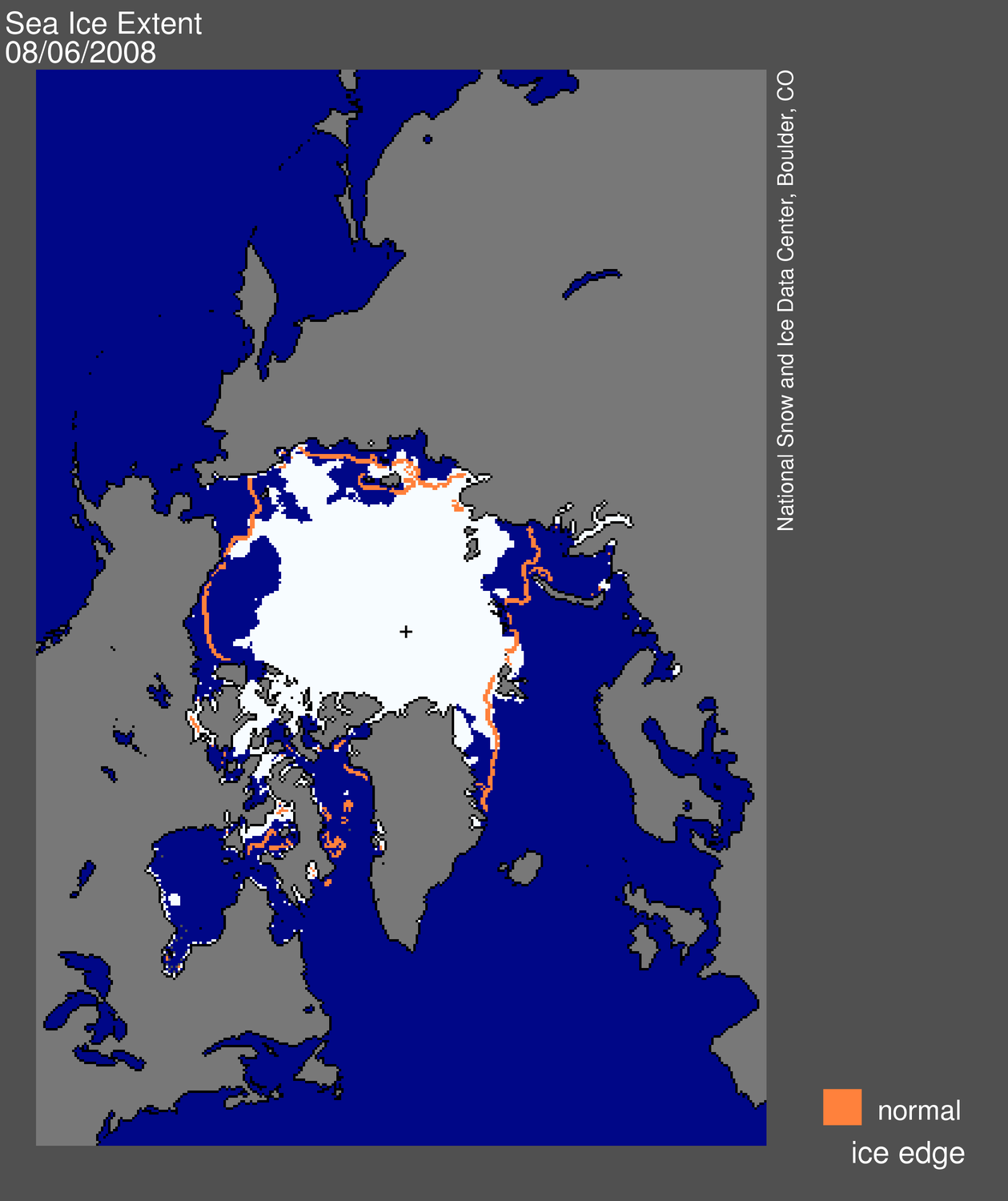
Also compare today’s image of sea ice melt:

NSIDC daily sea ice image for August 6, 2008

NSIDC daily sea ice image for August 6, 2008

With this one from just a week ago:

NSIDC daily sea ice image July 31, 2008

NSIDC daily sea ice image July 31, 2008

The ice appears to be melting fast now. Anyone taking bets on whether we set another new record this year?

Crossposted at Daily Kos

Posted by: JohnnyRook | July 31, 2008

When Ice Shelves Collapse: A Brief Tutorial

When I last diaried on the breakup of the Wilkins ice shelf there were a great many questions about glacier movement and sea-level rise so I thought that while we are waiting for the Wilkins ice shelf to collapse completely, it would be worthwhile to take the time to take a look at what causes ice shelves to break up and what the consequences of such a breakup are.

We can do this by examining the collapse of the Larsen B ice sheet, which took place in 2002.

Before we talk about ice shelves let me mention the wonderful overlay that the the British Antarctic Survey has released for Google Earth showing the breakup of Antarctic ice sheets. You can use it to locate and learn more about the ice sheets we’re going to look at in this diary. (The site also has a second interesting overlay from the UK Met Office’s Hadley Office with projections of regional temperature increases over this century.) To use the overlays you must first have Google Earth installed. If you don’t already have Google Earth you can get it here.

What is an ice shelf? Let’s begin with a definition from Wikipedia (you can also find a list of the world’s ice shelves at the same link):

An ice shelf is a thick, floating platform of ice that forms where a glacier or ice sheet flows down to a coastline and onto the ocean surface. Ice shelves are found in Antarctica, Greenland and Canada only.

This is different from an ice sheet which instead of floating on the sea rests on land and covers an area of at least 50,000 square kilometers.

Ice shelf collapse is a process that has taken place many times as the earth’s climate moved from glacial stages to interglacial ones. See: Catastrophic ice shelf breakup as the source of Heinrich event icebergs (subscription required).

As Climaticide has worsened scientists have observed an increase in the rate of ice shelf collapse.

In the last several decades, glaciologists have observed consistent decreases in ice shelf extent through melt, calving, and complete disintegration of some shelves.

The Ellesmere ice shelf reduced by 90 percent in the twentieth century, leaving the separate Alfred Ernest, Ayles, Milne, Ward Hunt, and Markham Ice Shelves. A 1986 survey of Canadian ice shelves found that 48 km². (3.3 cubic kilometers) of ice calved from the Milne and Ayles ice shelves between 1959 and 1974.[2] The Ayles Ice Shelf calved entirely on August 13, 2005. The Ward Hunt Ice Shelf, the largest remaining section of thick (>10 m) landfast sea ice along the northern coastline of Ellesmere Island, lost 600 square km of ice in a massive calving in 1961-1962.[3] It further decreased by 27% in thickness (13 m) between 1967 and 1999.[4] In summer 2002, the Ward Ice Shelf experienced another major breakup. [5]

Two sections of Antarctica’s Larsen Ice Shelf broke apart into hundreds of unusually small fragments (100’s of meters wide or less) in 1995 and 2002.

The most studied of the recent ice shelf collapses is that of the Larsen B ice shelf which was exceptionally large:

The disintegration of the huge Larsen B ice shelf in Antarctica was an unprecedented event in the past 10,000 years of geological history, a study has found.

In March 2002, scientists announced the Larsen B ice shelf on the Antarctic Peninsula had entered a phase of rapid break-up with more than 50 billion tons of ice spilling into the Weddell Sea to form thousands of massive icebergs. It had been known for many years that the ice shelf was thinning and in retreat but the speed of its final collapse astonished scientists. It took just 35 days for the Larsen B ice shelf to fall away completely after a Nasa satellite detected the first ruptures in the 1,255 square miles of ice at the end of January 2002.

Below is an image of the Larsen B ice shelf in January 2002 before it’s collapse:

Larsen B March 2002

Here is another image of the same ice shelf in March of the same year after the breakup had occurred:

Larsen B January 2002

And here is an animation of the collapse:

Larsen B animation

N.F. Glasser and T.A. Scambos (PDF) in their paper A structural geological analysis of the 2002 Larsen B ice shelf collapse give 5 reasons for the importance of Antarctic ice shelves:

Ice shelves fringe ~45% of the Antarctic continent. They are
important in global Earth-system processes for five main reasons:

(1) ice shelves play a significant role in the global ice-volume/sea-level system because the calving of icebergs from their termini accounts for ~90% of Antarctic ice loss (Vaughan and Doake, 1996; MacAyeal and others, 2003);

(2) ice shelves influence the dynamics, and therefore the system response time, of upstream inland Antarctic ice (Rott and others, 2002; De Angelis and Skvarca, 2003; Scambos and others, 2004);

(3) rapid heat exchange in sub-ice-shelf cavities has a significant impact on the global ocean heat
budget (Williams and others, 2001; Joughin and Padman, 2003);

(4) ice shelves are capable of entraining, transporting and depositing large quantities of glacigenic material (Evans and Pudsey, 2002; Evans and O´ Cofaigh, 2003; Glasser and others, 2006); and

(5) catastrophic iceberg-calving events from ice shelves have been proposed as a cause of major Late Quaternary climatic perturbations (Hulbe and others, 2004).

They go on to note that Antarctic ice shelves have retreated in two stage:

1. a climatically driven gradual retreat that lasted for years or decades

2. a sudden collapse phase

Warming of the atmosphere or ocean currents can be a major factor in ice shelf collapse.

moulin

Because mean summer temperatures have risen to near-melting and the length of the melt season has doubled during the last two decades,
meltwater ponds have appeared on the surface of many Antarctic Peninsula ice shelves during the melt season (Van den Broeke, 2005). It has been suggested that this meltwater acts as a mechanical force in the crevasses, causing breaks in the ice shelf and thus accelerating ice-shelf disintegration (MacAyeal and others, 2003; Scambos and others, 2003; Van der Veen, 2007).

Photo right: Meltwater stream flowing into a large moulin in the ablation zone (area below the equilibrium line) of the Greenland ice sheet. (Image courtesy Roger J. Braithwaite, The University of Manchester, UK via GISS)

NOTE: The image above is of a melt stream and moulin on an ice sheet. If the water reaches the bedrock the ice sheet rests upon it can lubricate the ice sheet bottom and speed up it’s movement. Since an ice shelf floats in the water, if melt water works to the bottom of the sheet, it may contribute to fracturing it but does not make it move faster.

If you look at the first image of the Larsen B ice shelf above you will note striated features on the part of the shelf nearest the sea. Behind the ice sheet one can see the glaciers that flow into it. The ice from the various glaciers come together as they enter the ice sheet, however they are not all moving at the same rate. The striations, then, are crevasses and rifts resulting from the lateral sheer as faster moving ice moves past slower moving ice.

According to Glasser’s and Scambos’s analysis:

Prior to collapse, large open-rift systems (with floating brash ice) were present offshore of Foyn Point and Cape Disappointment. In the years just preceding break-up, these rifts became more pronounced and ice blocks in the rifts rotated because of the strong lateral shear in the zone separating active and less-active flow units. Velocity mapping of the suture regions indicates that the major rifts are a recent feature of the ice shelf, and werenot present over ~20 years ago.

The collapse of the Larsen B ice shelf was the result of atmospheric and oceanic conditions in combination with structural weaknesses within the ice shelf. Glasser and Scambos summarize the forces at work in the followong chart:

Photobucket

Chart from Glasser and Scambos: A structural glaciological analysis of the 2002 Larsen B ice shelf collapse page 14 (PDF)

So, what were the consequences for sea-level rise of the collapse of this huge ice shelf? From the ice sheet itself directly, nothing. As the ice was already floating in the water it had no effect on sea levels. However it did have an indirect effect within a short time.

Two studies published in 2004 after the collapse of the Larsen B ice shelf, one by Scambos et. al. at the National Ice, Snow and Data Center, Glacier acceleration and thinning after ice shelf collapse in the Larsen B embayment, Antarctica and the other by E. Rignot et. al. at the Jet Propulsion Laboratory in Pasadena, Accelerated ice discharge from the Antarctic Peninsula following the collapse of Larsen B ice shelf (both available through the American Geophysical Union-subscription required)reached similar conclusions: after the collapse of the ice shelf, which had served as giant buttresses for the glaciers behind them, the rate of glacier flow increased between 3 and 8 times, depending on the glacier and the study.

According to Rignot:

The mass loss associated with the flow acceleration exceeds 27 km3 per year, and ice is thinning at rates of tens of meters per year. We attribute this abrupt evolution of the glaciers to the removal of the buttressing ice shelf. The magnitude of the glacier changes illustrates the importance of ice shelves on ice sheet mass balance and contribution ot sea level change.

Larsen B and Wilkins ice shelves

Temperature map is from the NASA Earth Observatory

It should be observed here that the Wilkins ice sheet whose collapse prompted this discussion is an anomaly. For one thing, glacier flow contributes only minimally to the ice shelf. Hence its collapse will not have the same sort of impact that the collapse of the Larsen B ice shelf did, the effect of which was a 0.1 to 0.16 mm sea level rise.

According to NASA’s Earth Observatory:

The Larsen Ice Shelf is “typical” in that it is primarily fed by a land-based glacier. The Wilkins Ice Shelf is somewhat unusual in that only the southern end of the shelf appears to be fed by land-based ice; the rest of the shelf may have formed from accumulation of sea ice that held fast to the coastline through many seasons, as well as snow cover. Glaciologists estimate that the part of the Wilkins Ice Shelf that formed from sea ice may be 300 to 400 years old, and the part that is fed by glacier flow is older, perhaps up to 1,500 years old. Because the Wilkins Ice Shelf is only marginally fed by glacier flow, however, its collapse was not expected to have the same impact on sea level rise as the collapse of the Larsen B potentially could.


Crossposted at Daily Kos

Posted by: JohnnyRook | July 29, 2008

Latest Ice Shelf Collapse: This One’s in the Arctic

The Associated Press has just announced that a 7 square mile piece of the Ward Hunt ice sheet, the largest ice sheet in the Arctic has collapsed. The ice sheet was first noticed to be fracturing in 2002. It was observed in April of this year that the ice shelf has broken into 3 pieces and fears were expressed that it would not survive the year. Ward Hunt is the remnant of a much larger ice sheet that surround Ellesmere Island until the beginning of the 20th century when it broke up into 6 pieces, the largest of which is the Ward Hunt, at 170 square miles and 130 feet thick.

Although small by comparison with the Antarctic ice shelves Ward Hunt has a long and storied history. The 2002 breakup was an ecological disaster as it wiped out the epishelf lake in Disraeli Fiord, a large body of freshwater that floated on top of the Arctic’s denser sea water.

Map of Ellesmere Island, Canada

According to the Globe and Mail:

(The G&M, reported that the piece that broke off was only 4 km2, but that may be only one of the three pieces)

Scientists say the break, the largest on record since 2005, is the latest indication that climate change is forcing the drastic reshaping of the Arctic coastline, where 9,000 square kilometres of ice have been whittled down to less than 1,000 over the past century, and are only showing signs of decreasing further.

“Once you unleash this process by cracking the ice shelf in multiple spots, of course we’re going to see this continuing,” said Derek Mueller, a leading expert on the North who discovered the ice shelf’s first major crack in 2002.

Aeriel view of crack on Ward Hunt ice shelf

Notice the fracture in the center of this photo from 2002. [NASA Photo)

Again from AP:

Gary Stern, co-leader of an international research program on sea ice, said it’s the same story all around the Arctic.

Speaking from the Coast Guard icebreaker Amundsen in Canada’s north, Stern said He hadn’t seen any ice in weeks. Plans to set up an ice camp last February had to be abandoned when usually dependable ice didn’t form for the second year in a row, he said.

“Nobody on the ship is surprised anymore,” Stern said. “We’ve been trying to get the word out for the longest time now that things are happening fast and they’re going to continue to happen fast.” [Emphasis–JR]

Ellesmere Island & Ward Hunt Ice Shelf

Another NASA photo of Ellesmere Island and the Ward Hunt ice shelf from 2003.

Below are two more photos from 2002, this one showing Disraeli Fiord where the epishelf lake was located.

Ward Hunt ice sheet with missing piece

NASA photos

You can see a photo of the current breakup at the Brisbane Times web site.

Currently sea ice melt in the Arctic, although well below the 1979-2000 average, is behind last year’s record pace. (Click on images in upper right of the link to see the latest image and graft. There is a one day lag, so today’s events will not be reflected in the graph until tomorrow.). Scientists, however, have remarked upon how thin the sea ice is this year. Thinner ice melts more easily, and if this latest news about the Ross Hunt ice shelf is any indicator, we may still get a record year before the summer is out.

Crossposted at Daily Kos

« Newer Posts - Older Posts »

Categories