Maybe the Mainstream Media is finally getting the message. As I reported on Thursday, NBC actually aired a piece on the their Nightly News about a new report from U.S. Climate Change Science Program linking Climaticide to extreme weather events.

Then yesterday Syndicated columnist, Amy Goodman, had a piece in the Seattle Post Intelligencer called Flooding is global warming at work in which she took the Mainstream Media to task for their failure to connect the dots in their reporting on extreme weather events and Climaticide. Double score here. Goodman reports on the link between Climaticide and extreme weather and criticizes the MSM for acting as if the connection does not exist.

In her article, Goodman cites Climate Progress’s Dr. Joseph Romm who points out that the increase in recent extreme weather events is “… is exactly what scientists have been telling us would happen because of human emissions”. [See Romm’s Blog for the science linking Climaticide to the increase in extreme weather. Also check out the Climate Extreme Index at NOAA’s National Climatic Data Center]

Climate Extremes Index from NOAA

Goodman went on to ask:

So if the disasters that follow one another, from hurricanes to tornadoes to flooding, are consistent with global warming, why aren’t the networks, the weather reporters, making the link?

According to Dr. Heidi Cullen of The Weather Channel it’s because most meteorologists don’t understand climate science, which is true as far as it goes. But meteorologists don’t normally make programming decisions. Those decisions are made by producers, station managers and station owners.

To really understand the MSM’s failure to report on Climaticide see Ross Gelbspan’s books, The Heat Is On: The Climate Crisis, The Cover-up, The Prescription and Boiling Point: How Politicians, Big Oil and Coal, Journalists, and Activists Have Fueled a Climate Crisis–And What We Can Do to Avert Disaster.

Also worth checking out is this interview Gelbspan gave to Mother Jones. Here’s a sample:

MJ.com: As you mentioned, you came across some of the deniers’ links to the coal industry. Can you talk more about that story and what you found out?

RG: I had done an article on the impact of climate change on public health in the Washington Post. After that piece ran, I got letters from readers who said, “Well, this is all well and good but we still don’t believe the climate is changing.” These letters referred me to the work of three prominent greenhouse skeptics: Fred Singer, Patrick Michaels, and Richard Lindzen. I read their work and I was persuaded that this issue was stuck in uncertainty, that there may not be a story here at all. But I had set up interviews with several other scientists and as a courtesy I decided to go ahead and keep those interviews. One of the scientists, who is a co-chair of the Intergovernmental Panel on Climate Change, showed me how these skeptics were being misleading in how they were manipulating data and really presenting a false picture. It really turned my head around. That scientist also said to me, “We’re puzzled because we don’t know where these folks are getting funded from. They’re not getting funded from the traditional public science funding sources.” I learned shortly thereafter that there was going to be a public hearing in Minnesota that was going to review the environmental impacts of coal burning. I found out that the fossil-fuel lobby was flying in four experts to testify. [At the hearing] the assistant attorney general compelled all these witnesses to disclose all their funding sources under oath. At that point, I realized that the coal industry had paid at least three of these greenhouse skeptics about $1 million over a three-year period. That propelled me to dig some more.

Goodman concludes her op-ed with a story about Ralph Nader’s grandmother and George Bush’s grandfather and then issues a (sort-of) call to arms.

Nader’s mother, Rose, shook the hand of Bush’s grandfather, Sen. Prescott Bush, R-Conn., and refused to let go until he agreed to build a dry dam. The dry dam got built, and Winsted hasn’t flooded since. A half-century later, our global problems have gotten far worse. Citizen activists need to shake not hands but the system, holding to account those with power and influence, from politicians to the personalities who report the weather on TV.[my emphasis]

I’m glad to have Goodman addressing this issue and pleased that she has has called for some sort of public action, but I don’t think she’s being forceful enough.

As I wrote in Americans Don’t Care about Global Warming on Daily Kos back in April:

Opposition in Congress and the gas and oil industries (which are virtually one and the same) keeps meaningful policies from being adapted. It also deludes the public into thinking that Climaticide is a minor problem, less important than the unemployment rate. The Media cowed by corporate sponsors whose advertising they fear to lose evades drawing the correct conclusions from the events they report. They provide the details and none of the context, telling us about killer tornadoes in Atlanta, crashing salmon fisheries in California and Oregon, droughts in the Southwest and floods the Midwest without ever mentioning climate change.

At this point I see no alternatives to mass protests and civil disobedience. The sort of things that get the attention of the people who don’t normally pay attention. I’m calling for civil disobedience outside of coal-fired power plants or whenever new coal-fired power plants are to be built, chaining ourselves to fences, bulldozers etc. Protests outside of government and corporate offices, including the offices of the media. Sometimes we might, peacefully, occupy those offices and refuse to leave until we get answers to our questions and commitments to act upon our demand. I would start with the major television media, insisting that the connect the dots when reporting on climate and that they investigate the relationship between professional denialists and the oil and gas companies, which fund them. Yes, we’ll make some people angry and some of us will spend a night in jail or pay a fine, but if we do this on a large enough scale we will make it impossible for the public to ignore this issue and, most importantly, the URGENCY of the issue. We can continue to use our keyboards and the Internet to protest and organize, but we also need to get up from our keyboards and rally, loudly, in the streets. It won’t be comfortable to do this, but if we do we will not have to recriminate ourselves as we sweat in 130 degree heat for what we did not do.

As a small step in getting the MSM’s attention I would encourage you to sign Climaticide Chronicles’ petition to the MSM demanding that news on Climaticide and extreme weather events be reported in the proper scientific context. Thanks.
Posted by: JohnnyRook | June 19, 2008

I Nearly Fell Off the Couch…

To my amazement NBC news ran a report on its evening news program from the U.S. Climate Change Science Program linking Climaticide to recent extreme weather events.

There has been an increase in the frequency of heavy downpours, especially over northern states, and these are likely to continue in the future, Thomas Karl, director of the National Climatic Data Center, said in a briefing Thursday.

For example, Karl said, by the end of this century rainfall amounts expected to occur every 20 years could be taking place every five years.

Such an increase “can lead to the type of events that we are seeing in the Midwest,” said Karl, though he did not directly link the current flooding to climate change.

It was careful, scientific language, but at least it made the connection.

I’m not going to get too excited yet, but I do hope that this is a sign that the MSM is finally going to start reporting extreme weather in context, instead of as random, isolated events.

For more on how the main stream media ignores Climaticide stories check out Joe Romm’s articles on Climate Progress.

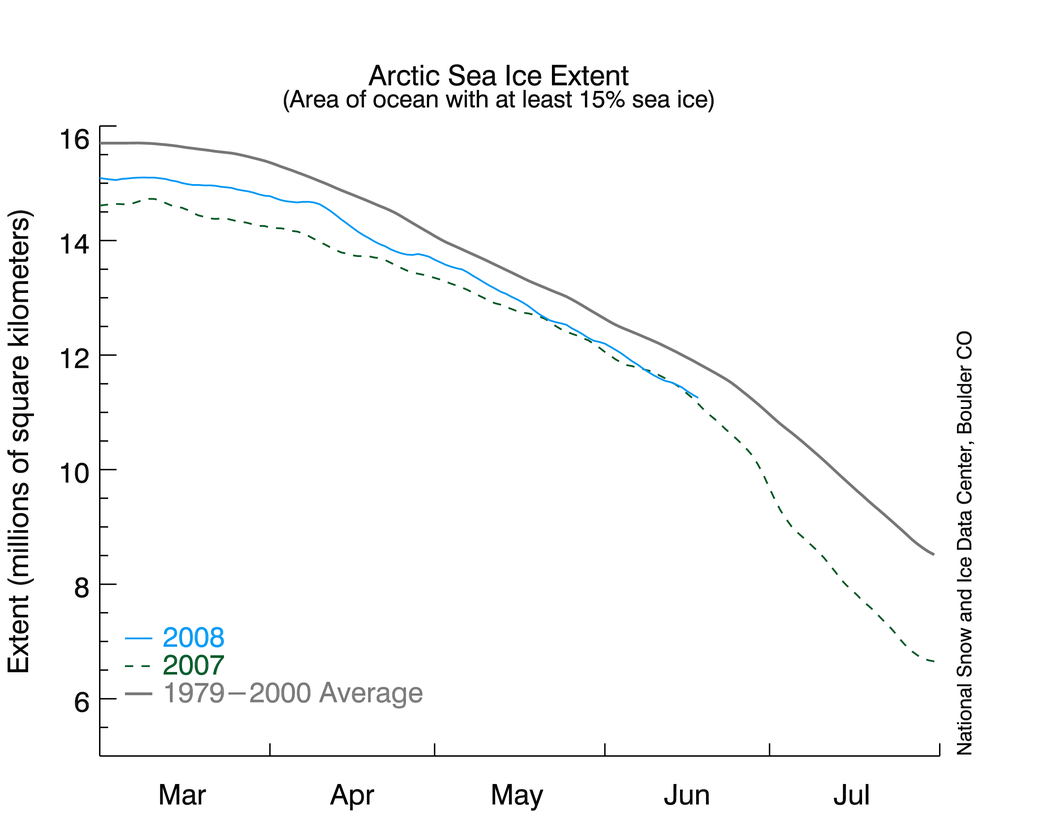
The latest data from the US National Snow and Ice Data Center (NSIDC) in Boulder Colorado show Arctic sea ice melt as of June 2008 to be as great as it was a year ago in June 2007 when all previous records were shattered. This despite the fact that in January 2008, ice extension was greater than a year earlier.

Arctic Sea Ice Melt from NSIDC

Scientists on the project say much of the ice is so thin as to melt easily, and the Arctic seas may be ice-free in summer within five to 10 years.

We had a bit more ice in the winter, although we were still way below the long-term average,” said Julienne Stroeve from NSIDC in Boulder, Colorado. “So we had a partial recovery. But the real issue is that most of the pack ice has become really thin, and if we have a regular summer now, it can just melt away,” she told BBC News.

When I began to write this post I thought I would contrast the current data with the denialists’ glee from earlier in the year when sea ice cover was greater than in the previous year. I did find a few examples of “those who rush in where angels fear to tread” which you can read here, here, here and here if you are so inclined, but overall there just wasn’t that much. On the other hand there were many articles about last year’s big thaw, the projection for another large melt this year, explanations about the significance of ice thinning, and projections for a total summer melt within the next 5-10 years.

That’s when it hit me that Climaticide denialists don’t really want to talk about the melting of the Arctic ice cap because the evidence is so overwhelming that there is no way that they can twist the data to make it seem to fit the denialist party line. Worse even, from the denialist point of view, focusing on the melting of the Arctic brings up other ever more disconcerting considerations.

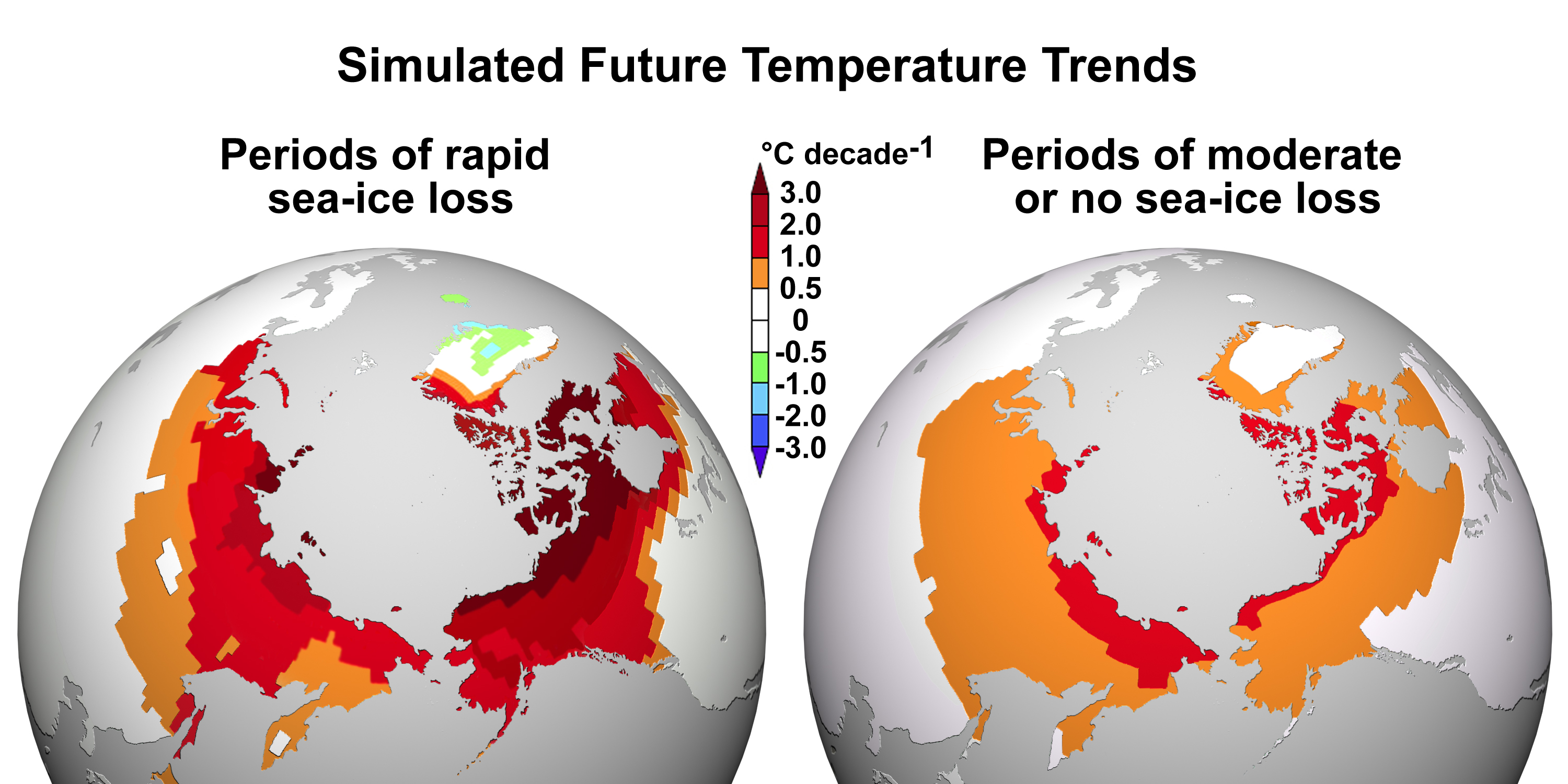
The rate of climate warming over northern Alaska, Canada, and Russia could more than triple during extended episodes of rapid sea ice loss, according to a new study from the National Center for Atmospheric Research (NCAR) and the National Snow and Ice Data Center (NSIDC). The findings raise concerns about the thawing of permafrost, or permanently frozen soil, and the potential consequences for sensitive ecosystems, human infrastructure, and the release of additional greenhouse gases.

[snip]

The findings point to a link between rapid sea ice loss and enhanced rate of climate warming, which could penetrate as far as 900 miles inland. In areas where permafrost is already at risk, such as central Alaska, the study suggests that periods of abrupt sea ice loss can lead to rapid soil thaw.

[snip]

Thawing permafrost may have a range of impacts, including buckled highways and destabilized houses, as well as changes to the delicate balance of life in the Arctic. In addition, scientists estimate that Arctic soils hold at least 30 percent of all the carbon stored in soils worldwide. While scientists are uncertain what will happen if this permafrost thaws, it has the potential to contribute substantial amounts of greenhouse gases to the atmosphere.

Behind that mild-mannered bit of science-speak lies the threat of a clathrate meltdown and skyrocketing levels of greenhouse gases (particularly methane) and temperature rises.

Relationship between Arctic sea ice melt and inland temperatures

Accelerated Arctic warming. Simulations by global climate models show that when sea ice is in rapid decline, the rate of predicted Arctic warming over land can more than triple. The image at left shows simulated autumn temperature trends during periods of rapid sea-ice loss, which can last for 5 to 10 years. The accelerated warming signal (ranging from red to dark red) reaches nearly 1,000 miles inland. In contrast, the image at right shows the comparatively milder but still substantial warming rates associated with rising amounts of greenhouse gas in the atmosphere and moderate sea-ice retreat that is expected during the 21st century. Most other parts of the globe (in white) still experience warming, but at a lower rate of less than 1 degree Fahrenheit (0.5 Celsius) per decade. (Image by Steve Deyo, ©UCAR.)

The unwillingness of Climaticide denialists to discuss Arctic sea ice melt is another twist on the importance of True Names. The Climaticide denialists’ superstitious belief that if they don’t talk about contrary evidence, it will somehow cease to exist or have consequences, shows just far they are, both in philosophical sophistication and intellectual integrity, from the reality-based scientists whose work they attempt to discredit.

Posted by: JohnnyRook | June 19, 2008

350, the Number Everyone Needs to Know

There are currently 387ppm of CO2 in the atmosphere. According to James Hansen of NASA’s Goddard Institute that’s already too much. Hansen’s research shows, based on models and paleoclimatological data, that any amount over 350ppm runs the danger of pushing us past tipping points beyond which catastrophic results will be impossible to avoid.

Bill McKibben and other anti-Climaticide activists have harkened to Hansen’s warning and have begun a campaign to guarantee that every person on the planet knows the significance of 350.

Why not check out the 350.org web site and see how you can get involved? We’re in a race to see if we can get to the critical mass where we can make real change happen before we get to the tipping points.

Posted by: JohnnyRook | June 19, 2008

Why Call it “Climaticide”? The Power of True Names

Welcome to the Climaticide Chronicles, a blog about politics, society, science and ethics with special attention to global warming and climate change. Climaticide is a term that I coined several months ago (only afterwards did I learn that the term already existed in French but with a narrower meaning) to describe the human-driven destruction of our Holocene-epoch climate, the climate in which our civilization has developed, thrived and prospered, and which we now threaten to irrevocably alter without regard to the consequences.

I chose Climaticide for several reasons: 1) It accurately describes what we humans are doing to our current climate, which is, quite simply, killing it. 2) It’s a catchy, easy to remember term (IMHO) 3) It avoids the ambiguity of other expressions such as global warming, which many people find confusing (“It’s not getting warmer where I live. Hell, we got a lot of snow here in the Pacific Northwest this winter. It’s June now and it’s still cold”) and climate change, which doesn’t sound sufficiently scary or urgent (“Not all change is bad, you know? “Maybe they’ll be able to grow watermelons in Helsinki…”) expressing instead a plainly obvious evil. (The Concise Oxford English Dictionary defines the suffix -cide “as denoting an act of killing”) and 4) it’s a perfectly apt descriptor not only of the process but also of the perpetrators: we are the climaticides, the killers of our climate. (Second COED definition of -cide: “denoting a person or substance that kills”)

Now, obviously, we will not destroy climate per se. What we may do however is destroy the climate to which we are so well adapted. If we fail to take the measures necessary to avoid that destruction (first limiting, then reducing our emission of CO2 and other greenhouse gases into the environment) we will create a world that is, at best, much less hospitable to human civilization, and, in the worst case , one in which not only human civilization but our survival as a species may well be impossible.

In her famous, fantasy novel A Wizard of Earthsea, Ursula Le Guin explores the power of what she calls “true names”. In Earthsea everything has two names only one of which is “true” or real. In order for a wizard or mage to have power over some object or person, he must know it’s true name. If one does not know the true name of something one cannot control it.

This is true in our world as well. Why have oil, coal, and gas companies and utilities spent so many millions to confuse the public about Climaticide? The answer is simple: they do not want us to know the true name and nature of the crisis we face. They want us to think that Climaticide is “natural”, slow acting, or too nebulous a concept for scientists ever to agree upon. They avoid calling things by their true names because they know that if we do not know the true names we will not be wise enough to act.

I use the term Climaticide because it is the true name of the crisis that threatens us. As the poet Thich Nhat Hanh has shown, calling things by their true names makes us aware of their complexity and wary of simplistic solutions.

Call Me by My True Names

Do not say that I’ll depart tomorrow
because even today I still arrive.

Look deeply: I arrive in every second
to be a bud on a spring branch,
to be a tiny bird, with wings still fragile,
learning to sing in my new nest,
to be a caterpillar in the heart of a flower,
to be a jewel hiding itself in a stone.

I still arrive, in order to laugh and to cry,
in order to fear and to hope.
The rhythm of my heart is the birth and
death of all that are alive.

I am the mayfly metamorphosing on the surface of the river,
and I am the bird which, when spring comes, arrives in time
to eat the mayfly.

I am the frog swimming happily in the clear pond,
and I am also the grass-snake who, approaching in silence,
feeds itself on the frog.

I am the child in Uganda, all skin and bones,
my legs as thin as bamboo sticks,
and I am the arms merchant, selling deadly weapons to
Uganda.

I am the twelve-year-old girl, refugee on a small boat,
who throws herself into the ocean after being raped by a sea
pirate,
and I am the pirate, my heart not yet capable of seeing and
loving.

I am a member of the politburo, with plenty of power in my
hands,
and I am the man who has to pay his “debt of blood” to my
people,
dying slowly in a forced labor camp.

My joy is like spring, so warm it makes flowers bloom in all
walks of life.
My pain is like a river of tears, so full it fills the four oceans.

Please call me by my true names,
so I can hear all my cries and laughs at once,
so I can see that my joy and pain are one.

Please call me by my true names,
so I can wake up,
and so the door of my heart can be left open,
the door of compassion.

In the Climaticide Chronicles my goal will always be to call things by their true names, for how we fare from now on is more dependent than ever on our being able to see and say the true names of things. I look forward to your help in discerning those names and then taking the necessary actions.

Thus it happens in affairs of state, for when the evils that arise have been foreseen (which it is only given to a wise man to see), they can be quickly redressed, but when, through not having been foreseen, they have been permitted to grow in a way that every one can see them. there is no longer a remedy [Niccoló Machiavelli, The Prince

[I originally posted this essay at Daily Kos back in May. I decided to repost it here because I believe that it details a fundamental psychological truth that needs to be understood by anyone working to stop Climaticide before it becomes an irreversible, disaster.]

A recent post by Joe Romm over at Climate Progress, The deniers are winning, especially with the GOP, in which he cited a Pew Poll showing that 13% fewer Republicans believe in global warming now than did a year ago, drew a huge number of denialist responses. After reading them all (groan) it struck me that it might be useful to analyze who climate denialists are and why they behave as they do.

Anyone who has tried to discuss Climaticide with a climate change denialist knows just how frustrating it can be. No matter how well informed you are, no matter how many peer-reviewed studies you cite, or how many times you point out the overwhelming agreement based on the evidence that exists among climate scientists that global warming is real and is principally caused by human fossil fuel use, you will get no where. Your adversary will deny the facts, cherry pick the scientific evidence for bits of data that, taken out of context, support his/her denialist view, or drag out long-debunked counter-arguments in the hope that they are unfamiliar to you and that you will not be able to refute them. If you succeed in countering all of his arguments he will most likely reword them and start all over again.

After a couple of hours of this, you end up frustrated, angry and confused. You give up and storm off vowing to study and learn even more so that next time you will be better prepared and able to convince the denialist of the error of his/her ways. But despite all your efforts, the next time you fare no better. What, you wonder, am I doing wrong?

The answer is simply that you are operating off of a mistaken premise. You think that the question of whether or not climate change is real and has an anthropogenic (human) cause is a question to be answered by application of an open mind, research, facts, and critical thinking. Isn’t that how scientists approach these problems? They’re skeptical and critique each others work, discarding ideas which fail to stand up to scrutiny by their colleagues and replacing them with ones that better describe the facts.

Denialists, however, have no interest in facts except as weapons in an ideological struggle. They don’t even care if “facts” are correct or not since their intention is not to establish that something is true or false, but rather to win a battle in an ideological war. If they can stump you or confuse you with a lie, well that works just as well for their purposes as does the truth.

When I speak about denialists, mind you, I’m not talking about people who are skeptical only because they are uninformed about the issue. Nor, am I talking about scientists who disagree with other scientists over the details of global warming i.e. What will the earth’s temperature be if we allow CO2 to reach 550 parts per million, twice the pre-industrial level (so-called climate sensitivity)?

No, the true climate change denialist is an ideologue. Understanding this fact is key to comprehending the denialist mentality and to knowing how to respond to denialist arguments.

Ideologues are adherents of closed, ideological systems, in which all problems are ultimately attributed to a single cause: original sin (Christianity), the accumulation of private property (Communism), restrictions imposed on a superior race by inferior ones (Fascism), the destruction of “freedom” by “Big Government” (Conservative/Libertarian). These are all a priori systems. Once the initial conclusion is reached (often after a long, complicated chain of deductive reasoning–Marx’s Capital, the writings of Ayn Rand, etc.) that factor X is the source of all of society’s ills, all debate outside the ideology’s framework ends. One may deduce new positions from the ideology’s fundamental principles, but the fundamental principles can not be questioned because such questioning might undermine the entire ideological system and the psychological security that it provides, leaving the true believer in that most urgently to be avoided of states: UNCERTAINTY. Ideology is thus, inevitably, by it’s very nature, anti-empirical.

An ideologue doesn’t believe that he needs to know the details of an issue in order to make policy decisions because his ideology provides him with a ready formula for solving all problems. Where ideologues run into difficulties however, is when the real world throws up problems that don’t fit the ideology’s problem categories.

For conservative/libertarian ideologues who compose the overwhelming majority of denialists, Climaticide is just such a case. If a conservative/libertarian ideologue were to accept global warming as real then he/she would be forced to admit that the problem is so big and so complex that government action is required to deal with it. But for an conservative/libertarian ideologue that is impossible because he/she believes that government is the cause of ALL problems and that the solution to all problems is “freedom”.

Denialists frequently make this attitude explicit when they accuse the “liberals” concerned about climate change of having invented it as an excuse to expand government. The latest version of this tactic that I’ve encountered is that none of the science in support of global warming need be taken seriously because it is the product of government-paid scientists who are only doing their bureaucratic masters’ bidding, apparently forgetting that the current “masters” are themselves Climaticide denialists.

Witness a denialist response to the assertion that most scientists believe in the reality of global warming from the Climate Progress blog I referenced above.

This is actual (sic) a very small group of people. It doesn’t include the millions of other scientist (sic) and engineers who have training in physics and chemistry and are quite capable of understaning (sic) the phony balony (sic) being tauted (sic) by the IPCC and its affilliated (sic) white-coated welfare queens. [my emphasis]

Government science is corrupt science because it’s government science. “Scientist’s” in the pay of the oil and gas industries on the other hand are free of this corruption because they are doing science for the capitalist heroes who defend our “freedom”.

The Soviets understood this way of thinking perfectly because Marxism too is an ideology, only in Marxism the great enemy is not the State but private capital. It’s no accident that in the former Soviet Union a clear distinction was made between bourgeois science and Soviet science. According to this view there are no facts only political points of view.

That there are no facts outside the “truths” of one’s ideology is a basic, if not always publicly expressed, tenet, of all ideologues be they religious zealots, communists, fascists or libertarian-conservatives.

Arguing with such people is a waste of time because they only listen to facts in order desperately to compose counter arguments. I say desperately because ideologues find psychological safety from an uncertain world in the certainties of their ideology. What you think of as an argument about global warming, they perceive as an attack on their entire world view. And they’re right of course, even though it’s not your intention.

So how does one talk to a climate denialist? I think a good answer comes from JMG’s comment on the Climate Progress blog that inspired this diary.

I once took a seminar on politics from a very successful campaign manager. He pointed out that the typical wonk (insert: scientist) will find a crowd of people and, within a few minutes, is in a hot debate with the person most opposed to his opinions. And that the smart pol disengages with that person as fast as possible, using his time to reach out to and reinforce his connection to the people who are already favorably disposed to him or have not yet reached a conclusion.

I’ve observed the unfortunate wonky tendency in myself over the years, and I sure as hell have observed it in nearly all the climate scientists and policy wonks — they’re so busy chasing idiots like the one above that they don’t have time to reach the persuadables.

In short, one should generally ignore the denialists and concentrate on persuading the open minded. They are the ones you should be trying to reach. The denialists are already beyond the pale. They will only be convinced once all the sea ice and polar bears are gone, it’s a 130 degrees in the shade in a drought-stricken Las Vegas and we have suffered multiple large scale disasters on our own territory, if then.

Now lest I be accused of simplifying reality myself, let me add a few words about what I perceive as the 4 basic categories of Climaticide denialists and their relationship to ideology.

The categories are:

1. Plutocrats

2. Shills

3. Literate conservative/libertarian ideologues

4. The right-wing booboisie

For the plutocrats, ideology is mostly a cover for their greed and a thin salve for whatever conscience they have left. For the shills (scientists and academics paid by the plutocrats to deny global warming), ideology is an indispensable tool, required by their corporate masters, and useful in providing intellectual ammunition to categories 3 and 4 and for bamboozling the uninformed public at large. For information on the relationships between the plutocrats and the shills follow this link and click on MAP EXXON’S NETWORK.

For the literate ideologues, their ideology is central to their political views and to their world view. I suspect that there are many engineers and other technical professionals in this category along with much of the business class, but that is a subject for another diary. The right-wing booboisie, (the Rush Limbaugh fanatics et.al) have also bought the conservative/libertarian ideological view but they purchased it in the alley at the back door, since they would never be allowed into the store through the front door. These are the resentful poor and poorly educated who have bought the culture wars frame or who, because of their social conservatism have embraced the ideology of the Robber Barons in a fight against mythical elites who keep them enslaved by driving Volvos, drinking lattes and removing their 10-commandment plaques from public buildings. I suspect that booboisie also harbors hopes of some day becoming plutocrats themselves, once the oppressive hand of Big Government is lifted from them and their “freedom” is restored.

For those of us in the reality-based community, understanding the role that conservative/libertarian ideology plays in determining Climaticide denialist behavior, whether sincere or simulated, can be very useful in making sense of the denialist position, a position which, ultimately, is rooted not in facts and critical thinking, but in political and psychological needs.

« Newer Posts

Categories