Two new articles accepted for publication by the American Geophysical Union, but not yet published, shed more light on alpine glacier shrinkage and on glacier contribution to sea level rise. The first of the articles examines the retreat of glaciers in Bolivia’s Cordillera Real.

Figure 1. Map of glaciers in the Cordillera Real. The studied area is shown in the red square. Meteorological stations are shown on the map.

Glacier decline between 1963 and 2006 in the Cordillera Real, Bolivia

<a href=”“>As in other areas of the world, the Himalayas, Chile, Switzerland, etc. research shows a decline in the mass balance (accumulation-ablation) of the Bolivian glaciers.

As the research team lead by Alvaro Soruco of IRD-LGGE, BP 96, 38402 Saint Martin d’Hères, France. writes:

The volume changes of 21 glaciers in the Cordillera Real have been determined between 1963 and 2006 using photogrammetric measurements. These data form the longest series of mass balances obtained with such accuracy in the tropical Andes. Our analysis reveals that temporal mass balance fluctuations are similar, revealing a common response to climate over the entire studied region. The mass of these glaciers has clearly been decreasing since 1975 without any significant acceleration of this trend over recent years. We have found a clear relationship between the average mass balance of these glaciers as a function of exposure and altitude. From this relationship, the ice volume loss of 376 glaciers has been assessed in this region. The results show that these glaciers lost 43 % of their volume between 1963 and 2006, essentially over the 1975-2006 period and 48% of their surface area between 1975 and 2006.

… mass balance variability and precipitation variability differ by almost an order of magnitude. A change in precipitation of less than 70 mm cannot directly explain changes in mass balances larger than 500 mm. Considering that the precipitation lapse rate is small [Sicart et al., 2007], it would be tempting to conclude that the influence of precipitation on mass balance is low. However, as shown in previous studies [Wagnon et al., 2001; Sicart, 2002], the feedback on albedo induced by solid precipitation is more significant in explaining the large variability of annual glacier mass balance than the annual variability of accumulation itself. Indeed, although precipitation is weak, a thin snow cover of high albedo is sufficient to stop an intense melting.

In any case, note that the interannual mass balance variability, shown for Zongo Glacier greatly exceeds the decadal variability. For instance, the mass loss of Zongo over the two years 1997-1999 corresponds to 60% of the 1997-2006 loss (Figure 2a) and reveals that annual mass balances are strongly affected by ENSO events [Wagnon et al., 2001].

In addition, our measurements relative to the sample of 21 glaciers over the 1963-2006 period show that the area changes are poorly related to mass balance over each period (R²<0.15) and over the whole period (R²=0.08). Detailed measurements of area/length changes on the Zongo glacier [Vuille et al., 2008] lead to the same conclusion. Indeed, the strong retreat observed over the 1992-2006 period compared to the 1963-2006 average does not reflect the mass balance evolution. This confirms that area or length changes are poor indicators for climate change analysis at a decadal time-scale.

[See the discussion in the second article below for an possible explanation of what does drive area or length changes]

Centred mass balance analysis over four periods between 1963 and 2006 shows that temporal mass balance fluctuations are similar, revealing a common response to climate over the entire studied region, except for the smallest glaciers which can be strongly affected by local conditions.

The cumulative mass balances of these glaciers do not show any acceleration of the trend. The strong retreat of the Zongo snout observed over the 1992-2006 period does not reflect the mass balance changes of this glacier. Although our dataset does not allow us to clearly link the mass balance variations with precipitation and temperature variations, mass balance variations observed at a decadal scale are roughly in agreement with temperature and precipitation changes.

The differences of the cumulative mass balance trends observed over the 1963-2006 period can be explained to a large extent by the exposure and altitude of each glacier. The highest glaciers and glaciers with exposures between east and south experienced less negative mass balances. Using the strong relationship found between mass balance, exposure and altitude, the ice volume loss of 376 glaciers assessed in this region over the period 1963-2006, corresponds to 43% of their volume. In addition, our surface area measurements of these 376 glaciers indicate an overall shrinkage in glacier area of 48% between 1975 and 2006. In the future, these results will be used to assess the impact of glaciers shrinkage on water runoff, especially for La Paz city.

Huayna Potosí in the Central Bolivian Cordillera

The second AGU article lead by David B. Bahr of the Department of Physics and Computational Science, Regis University, Denver, CO. looks at the accumulation area of glaciers and icecaps relative to mass volume.

Sea-level rise from glaciers and ice caps: a lower bound

One of the most easily measured dimensions of a glacier, the accumulation area, is linked to future changes in glacier volume and consequent changes in sea level. Currently observed accumulation areas are too small, forcing glaciers to lose 27% of their volume to attain equilibrium with current climate. As a result, at least 184 ± 33 mm of sea-level rise are necessitated by mass wastage of the world’s mountain glaciers and ice caps even if the climate does not continue to warm. If the climate continues to warm along current trends, a minimum of 373 ± 21 mm of sea-level rise over the next 100 years is expected from glaciers and ice caps. When compared to recent estimates from all other sources, melt water from glaciers must be considered as a particularly important fraction of the total sea-level rise expected this century.

In other words, where accumulation areas are too small, one can predict by what percentage glaciers will shrink in the future as well as make additional predictions regarding the contribution of glacier melt to sea level rise. The authors are thus able to deduce how much glacial melt will contribute to sea level rise even if the climate warms no further as well as how much it will rise if it continues to warm at current rates.

On average, a glacier in equilibrium will accumulate snow on its upper reaches and ablate snow and ice at its lower elevations. The [accumulation area ratio] AAR is the ratio of the accumulation area to the area of the entire glacier, with values for healthy glaciers ranging from approximately 0.4 to 0.8 (Meier and Post, 1962). Variations in the equilibrium AAR are caused by differences in glacier shapes and mass balance profiles, (x), which give the net accumulation minus ablation of snow and ice at any position x. The balance profile is a direct consequence of climate (precipitation and temperature) which can vary both regionally and locally due to orographic and other meteorological factors.

If we assign each glacier an equilibrium AAR0 that indicates its value when the glacier’s net balance is zero, then an AAR < AAR0 indicates that the accumulation area has shrunk, the glacier is overextended, and the glacier must retreat to reach a new equilibrium with current climate. This hypothesized retreat involves the implicit but reasonable assumption that changes in the balance regime happen quickly relative to changes in the area of the glacier. Typical e-folding response times for glacier flow range from 10’s to 1000’s of years depending on the glacier’s size (Bahr et al., 1998; Pfeffer et al., 1998; Jóhannesson et al., 1989), while a glacier’s climate can change every year. Therefore, as the climate warms, a glacier’s current AAR will not represent an equilibrium value. To reach an equilibrium with the current climate, the glacier will have to slowly change size until AAR = AAR0. Note that in this case, the AAR is an observed medium term average, calculated over a period long enough to eliminate interannual variability but significantly shorter than the time scale of adjustment to equilibrium.

Our estimate places no bounds on time and only indicates the final outcome after all glaciers reach equilibrium. Therefore, it is possible that the additional ~80 mm represents sea-level rise that will occur after the 100 year time scale of previous estimates. However, with an e-folding response time that averages on decadal to century time scales for most glaciers, the bulk of the 184 mm of predicted rise is expected within this century.

Long term mass balance data from 86 mountain glaciers and ice caps from around the world shows that the equilibrium AAR0 differs for each glacier but averages 0.57 ± 0.01 (see Supplementary Data). The same data indicate that the average AAR from 1997-2006 is only 0.44 ± 0.02, suggesting that glaciers and ice caps around the world are out of equilibrium, as expected. The ratio AAR / AAR0 = αr gives a measure of the extent to which each glacier is out of equilibrium (Dyurgerov et al., submitted), and in this case 1 – αr = 0.23 or approximately 23% out of equilibrium on average. The following analysis converts each glacier’s αr to a change in glacier volume. By summing over all glaciers this gives an estimate of sea-level rise.

If a similar reduction of AARs occurs over the next 30 to 40 years, then we can reasonably expect the average AAR to drop linearly from roughly 0.54 in 1961 to 0.44 in 2007 to 0.31 by 2050. This is a conservative estimate – observations indicate a faster than linear decrease in global ice mass balance over the last 40 years (Kaser et al., 2006). Although the actual decrease in AAR may be faster than linear, this conservative estimate represents a 30% decrease from the current value. As a rough approximation, we can assume that the AAR of every glacier decreases by the same percentage, giving an estimate of the fractional volume change pv for each glacier. In that case, the minimal sea-level rise from glaciers and ice caps will more than double to 373 ± 21 mm over the next 100 years.

Posted by: JohnnyRook | January 2, 2009

James Hansen Sends a Letter to Michelle and Barack Obama

Here is the full text of the letter {PDF) Dr. James Hansen’s has sent to Michille and Barack Obama. As it was copied from a PDF the formatting may not always be right. I have my doubts about some of what Dr. Hansen proposes, most specifically his endorsement of nuclear power and “clean” coal, but whether you always agree with him or not, he is always worth listening to.

Thanks to the people on my e-mail list for all the suggestions (more than 100!) about my draft “Tell Barack Obama the Truth – the Whole Truth”. Most frequent criticism: the need for an executive summary. Two people suggested: put a summary in the form of a letter to Michelle and Barack Obama. I like that idea. They are equally smart lawyers, and if we can get eitherof them to really focus on the actions that are needed, the planet has a chance.

The letter turned out to be four pages. Sorry. But I wrote a note to John Holdren, which can serve as an executive summary. John has promised to deliver the letter, but cannot do so prior to the inauguration. That delay is a problem for one of the three recommendations: tax and dividend. Thus I am making the letter available [here PDF]

and the revised

Tell Barack Obama the Truth in hopes of getting the information to people who continue to push for “goals” and “caps”. “Goals” for percentage CO2 emission reductions and “cap & trade & dividend” are a threat to the planet, weak tea, not commensurate with the task of getting CO2 back to 350 ppm and
less.

Note:

(1) There must be a tax at the mine or port of entry, the first sale of oil, gas and coal, so every direct and indirect use of the fuel is affected. Anything less means that the reduction of demand for the fuel will make it cheaper for some uses; e.g., people will start burning coal in their stoves. Peter Barnes’ idea to push the cap upstream to the extent possible is not adequate nor is a ‘gas tax’ suggested by NY Times and others. A comprehensive approach is needed.

(2) “Cap & trade & dividend” creates Wall Street millionaires and complex bureaucracy. The public is fed up with that – rightly so. A single carbon tax rate can be adjusted upward affecting all activities appropriately. With 100% dividend the public will allow a carbon price adequate to the job, i.e., helping us move to the postfossil-
fuel world.

(3) Supply ‘caps’ cannot yield a really big reduction because of the weapon: shortages’. All a utility has to say is ‘blackout coming’ and politicians and public have to cave in – we are not going to have the lights turned out. Will the public allow a high enough tax rate? Yes, dividends will exceed tax for most people concerned about their bills.

(4) A tax is not sufficient. All other measures, such as building codes, are needed. But with millions of buildings, all construction codes and operations cannot be enforced. A rising carbon price provides effective enforcement.

(5) Wouldn’t it be cheaper to let people burn the dirtiest fuel? No. The clean future that we aim for, including more efficient energy use, is not more expensive. For example, you may have read about passively heated homes that require little energy and increase construction costs only several percent. Such possibilities remain the oddball (with high price tag), not the standard construction, unless the government adopts policies that make things happen.

Some of you suggested that I should only explain the urgency of the climate crisis, the need to get back to 350 ppm CO2 and less. Politicians are happy if scientists provide information and then go away and shut up. But science and policy cannot be divorced. What I learned in the past few years is that politicians often adopt convenient policies that can be shown to be inconsistent with long-term success, given readily available scientific data and empirical information on policy impacts.

Jim Hansen

[Here is Dr. Hansen’s note to John Holdren, President-elect Obama’s science advisor.]

Dear John,
A few weeks ago in London, where Anniek was running after me from one meeting to
another, she had a heart attack (fortunately we were near a very good hospital — the problem should be permanently fixed via the stent they inserted plus a better diet). As we waited a week for her to be able to fly I wrote the attached letter to the Obamas. Could you possibly forward this letter to them?

I realize that it is a long letter (4 pages + a page of footnotes). But global warming likely will be, eventually, the problem of their lifetime. His presidency may be judged in good part on whether he was able to turn the tide — more important, the futures of young people and other life will depend on that. So four pages may not be intolerably long.

My hope is that he (even better they) will want to understand the matter, not just rely on advisers. I refer not to the details of climate science, but rather what needs to be done. The danger is that the compromises and special interests inherent in Kyoto-style targets and cap-and-trade will be accepted because of bureaucratic momentum. Other intolerable aspects of current approaches are the escape hatches (plant a tree somewhere, reduce some other gas, etc.). Carbon dioxide is special because of its strange lifetime (eventually exceedingly long) and the fact that it acidifies the ocean. Also it needs to be recognized that forestation can not be traded for more fossil fuels because the forests are needed to help bring down the current amount of CO2.

The three points that I raise concern: (1) coal, (2) carbon tax, and (3) nuclear power.

(1) The critical need to cut off the coal source soon must be recognized. I was surprised that in 90 minutes I could not get the German Environmental Minister to understand that their proposed “carbon cap” would not allow them to build 20 more coal-fired power plants. I kept saying “if you burn more coal you must convince Russia to leave its oil in the ground” and he would say “we will tighten the carbon cap”. Japan thinks that it did fine in meeting its Kyoto obligations, even though its coal use and CO2 emissions increased. [Japan used Kyoto allowed escape hatches. The Earth has no escape hatch.]

(2) A carbon tax (across all fossil fuels at their source) is essential, I believe, for
effectiveness. Any less comprehensive cap will reduce the price of the fuel for any other
uses. A rising tax (with all the other needed measures such as building codes, vehicle efficiencies, renewable energies…) will help constrain demand for the fuel. When gasoline hits $4-5/gallon again, most of that should be tax staying in the country and returned as dividend, providing the consumer the means to purchase more efficient products and incentive for entrepreneurs to develop them. A rising tax will help keep the price paid for the oil itself (or other fossil fuel) lower, thus making it unprofitable to go to the most extreme places on the planet to extract the last drop of oil. Instead we can move on sooner to the energies of the post-fossil-fuel-era.

A carbon cap that makes one more stinking millionaire on the backs of the public is going to infuriate the public. Me too. There is no need to support lobbyists, traders, and special interests. The tax should be proportional to the carbon amount and the dividend calculation will only require long division, which even a civil servant can do. 100% of the tax should go into the dividends. However, if some countries do not apply an equivalent tax, a duty should be collected on fossil-fuel dependent products imported from that country. Such import duties might be used, in part, to finance reforestation, climate adaptation, or other climate or energy related needs.

(3) Nuclear power: it would be great if energy efficiency, renewable energies, and an
improved (“smart”) electric grid could satisfy all energy needs. However, the future of our children should not rest on that gamble. The danger is that the minority of vehement antinuclear “environmentalists” could cause development of advanced safe nuclear power to be slowed such that utilities are forced to continue coal-burning in order to keep the lights on.

That is a prescription for disaster.There is no need for a decision to deploy nuclear power on a large scale. What is needed is rapid development of the potential, including prototypes, so that options are available. We have to avoid a “FutureGen” sort of drag-out. It seems to me that it is time to get fed-up with those people who think they can impose their will on everybody, and all the consequences that might imply for the planet, by putting this R&D on a slow boat to nowhere instead of on
the fast-track that it deserves.

I hope that you will be willing to forward this to the Obamas. Wishing you the best for the holiday season, and especially success in your new job!

Best regards,
Jim Hansen

[Here is the letter proper]

29 December 2008
Michelle and Barack Obama
Chicago and Washington, D.C.
United States of America

Dear Michelle and Barack,
We write to you as fellow parents concerned about the Earth that will be inherited by our children, grandchildren, and those yet to be born. Barack has spoken of ‘a planet in peril’ and noted that actions needed to stem climate change have other merits. However, the nature of the chosen actions will be of crucial importance.

We apologize for the length of this letter. But your personal attention to these ‘details’ could make all the difference in what surely will be the most important matter of our times. Jim has advised governments previously through regular channels. But urgency now dictates a personal appeal. Scientists at the forefront of climate research have seen a stream of new data in the past few years with startling implications for humanity and all life on Earth.

Yet the information that most needs to be communicated to you concerns the failure of policy approaches employed by nations most sincere and concerned about stabilizing climate. Policies being discussed in national and international circles now, which focus on ‘goals’ for emission reduction and ‘cap and trade’, have the same basic approach as the Kyoto Protocol.

This approach is ineffectual and not commensurate with the climate threat. It could waste another decade, locking in disastrous consequences for our planet and humanity.
The enclosure, “Tell Barack Obama the Truth – the Whole Truth” was sent to colleagues for comments as we left for a trip to Europe. Their main suggestion was to add a summary of the specific recommendations, preferably in a cover letter sent to both of you.

There is a profound disconnect between actions that policy circles are considering and what the science demands for preservation of the planet. A stark scientific conclusion, that we must reduce greenhouse gases below present amounts to preserve nature and humanity, has become clear to the relevant experts. The validity of this statement could be verified by the National Academy of Sciences, which can deliver prompt authoritative reports in response to a Presidential requesti. NAS was set up by President Lincoln for just such advisory purposes.

Science and policy cannot be divorced. It is still feasible to avert climate disasters, but only if policies are consistent with what science indicates to be required. Our three recommendations derive from the science, including logical inferences based on empirical information about the effectiveness or ineffectiveness of specific past policy approaches.

(1) Moratorium and phase-out of coal plants that do not capture and store CO2.
This is the sine qua non for solving the climate problem. Coal emissions must be phased out rapidly. Yes, it is a great challenge, but one with enormous side benefits.
Coal is responsible for as much atmospheric carbon dioxide as the other fossil fuels
combined, and its reserves make coal even more important for the long run. Oil, the second greatest contributor to atmospheric carbon dioxide, is already substantially depleted, and it is impractical to capture carbon dioxide emitted by vehicles. But if coal emissions are phased out promptly, a range of actions including improved agricultural and forestry practices could bring the level of atmospheric carbon dioxide back down, out of the dangerous range.

As an example of coal’s impact consider this: continued construction of coal-fired power
plants will raise atmospheric carbon dioxide to a level at least approaching 500 ppm (partsper million). At that level, a conservative estimate for the number of species that would be exterminated (committed to extinction) is one million. The proportionate contribution of a single power plant operating 50 years and burning ~100 rail cars of coal per day (100 tons of coal per rail car) would be about 400 species! Coal plants are factories of death. It is no wonder that young people (and some not so young) are beginning to block new construction.

(2) Rising price on carbon emissions via a “carbon tax and 100% dividend”.

A rising price on carbon emissions is the essential underlying support needed to make all other climate policies work. For example, improved building codes are essential, but full enforcement at all construction and operations is impractical. A rising carbon price is the one practical way to obtain compliance with codes designed to increase energy efficiency.

A rising carbon price is essential to “decarbonize” the economy, i.e., to move the nation
toward the era beyond fossil fuels. The most effective way to achieve this is a carbon tax (on oil, gas, and coal) at the well-head or port of entry. The tax will then appropriately affect all products and activities that use fossil fuels. The public’s near-term, mid-term, and long-term lifestyle choices will be affected by knowledge that the carbon tax rate will be rising.

The public will support the tax if it is returned to them, equal shares on a per capita basis (half shares for children up to a maximum of two child-shares per family), deposited monthly in bank accounts. No large bureaucracy is needed. A person reducing his carbon footprint more than average makes money. A person with large cars and a big house will pay a tax much higher than the dividend. Not one cent goes to Washington. No lobbyists will be supported. Unlike cap-and-trade, no millionaires would be made at the expense of the public.

The tax will spur innovation as entrepreneurs compete to develop and market low-carbon and no-carbon energies and products. The dividend puts money in the pockets of consumers, stimulating the economy, and providing the public a means to purchase the products.

A carbon tax is honest, clear and effective. It will increase energy prices, but low and
middle income people, especially, will find ways to reduce carbon emissions so as to come out ahead. The rate of infrastructure replacement, thus economic activity, can be modulated by how fast the carbon tax rate increases. Effects will permeate society. Food requiring lots of carbon emissions to produce and transport will become more expensive and vice versa, encouraging support of nearby farms as opposed to imports from half way around the world.

The carbon tax has social benefits. It is progressive. It is useful to those most in need in hard times, providing them an opportunity for larger dividend than tax. It will encourageillegal immigrants to become legal, thus to obtain the dividend, and it will discourage illegal immigration because everybody pays the tax, but only legal citizens collect the dividend.

“Cap and trade” generates special interests, lobbyists, and trading schemes, yielding non-productive millionaires, all at public expense. The public is fed up with such business. Tax with 100% dividend, in contrast, would spur our economy, while aiding the disadvantaged, the climate, and our national security.

(3) Urgent R&D on 4th generation nuclear power with international cooperation.
Energy efficiency, renewable energies, and a “smart grid” deserve first priority in our
effort to reduce carbon emissions. With a rising carbon price, renewable energy can perhaps handle all of our needs. However, most experts believe that making such presumption probably would leave us in 25 years with still a large contingent of coal-fired power plants worldwide. Such a result would be disastrous for the planet, humanity, and nature.

4th generation nuclear power (4th GNP) and coal-fired power plants with carbon capture
and sequestration (CCS) at present are the best candidates to provide large baseload nearlycarbon-free power (in case renewable energies cannot do the entire job). Predictable criticism of 4th GNP (and CCS) is: “it cannot be ready before 2030.” However, the time needed could be much abbreviated with a Presidential initiative and Congressional support. Moreover, improved (3rd generation) light water reactors are available for near-term needs.

In our opinion, 4th GNPii deserves your strong support, because it has the potential to
help solve past problems with nuclear power: nuclear waste, the need to mine for nuclear fuel, and release of radioactive materialiii. Potential proliferation of nuclear material will always demand vigilance, but that will be true in any case, and our safety is best secured if the United States is involved in the technologies and helps define standards.

Existing nuclear reactors use less than 1% of the energy in uranium, leaving more than
99% in long-lived nuclear waste. 4th GNP can “burn” that waste, leaving a small volume of waste with a half-life of decades rather than thousands of years. Thus 4th GNP could help solve the nuclear waste problem, which must be dealt with in any case. Because of this, aportion of the $25B that has been collected from utilities to deal with nuclear waste justifiably could be used to develop 4th generation reactors.

The principal issue with nuclear power, and other energy sources, is cost. Thus an R&D objective must be a modularized reactor design that is cost competitive with coal. Without such capability, it may be difficult to wean China and India from coal. But all developing countries have great incentives for clean energy and stable climate, and they will welcome technical cooperation aimed at rapid development of a reproducible safe nuclear reactor.

Potential for cooperation with developing countries is implied by interest South Korea
has expressed in General Electric’s design for a small scale 4th GNP reactor. I do not have the expertise to advocate any specific project, and there are alternative approaches for 4th GNP (see enclosure). I am only suggesting that the assertion that 4th GNP technology cannot be ready until 2030 is not necessarily valid. Indeed, with a Presidential directive for the Nuclear Regulator Commission to give priority to the review process, it is possible that a prototype reactor could be constructed rapidly in the United States.

CCS also deserves R&D support. There is no such thing as clean coal at this time, and it is doubtful that we will ever be able to fully eliminate emissions of mercury, other heavy metals, and radioactive material in the mining and burning of coal. However, because of the enormous number of dirty coal-fired power plants in existence, the abundance of the fuel, and the fact that CCS technology could be used at biofuel-fired power plants to draw down
atmospheric carbon dioxide, the technology deserves strong R&D support.

Summary

An urgentiv geophysical fact has become clear. Burning all the fossil fuels will destroy the planet we know, Creation, the planet of stable climate in which civilization developed.

Of course it is unfair that everyone is looking to Barack to solve this problem (and other
problems!), but they are. He alone has a fleeting opportunity to instigate fundamental
change, and the ability to explain the need for it to the public.

Geophysical limits dictate the outline for what must be done. Because of the long lifetime of carbon dioxide in the air, slowing the emissions cannot solve the problem. Instead a large part of the total fossil fuels must be left in the ground. In practice, that means coal.

The physics of the matter, together with empirical data, also define the need for a carbon tax. Alternatives such as emission reduction targets, cap and trade, cap and dividend, do not work,as proven by honest efforts of the ‘greenest’ countries to comply with the Kyoto Protocol:

(1) Japan: accepted the strongest emission reduction targets, appropriately prides itself on having the most energy-efficient industry, and yet its use of coal has sharply increased, as have its total CO2 emissions. Japan offset its increases with purchases of credits through the clean development mechanism in China, intended to
reduce emissions there, but Chinese emissions increased rapidly.

(2) Germany: subsidizes renewable energies heavily and accepts strong emission reduction targets, yet plans to build a large number of coal-fired power plants. They assert that they will have cap-and-trade, with a cap that reduces emissions by whatever amount is needed. But the physics tells us that if they continue to burn coal, no cap can solve the problem, because of the long carbon dioxide lifetime.

(3) Other cases are described on my Columbia University web site, e.g., Switzerland finances construction of coal plants, Sweden builds them, and Australia exports coal and sets atmospheric carbon dioxide goals so large as to guarantee destruction of much of the life on the planet.

Indeed, ‘goals’ and ‘caps’ on carbon emissions are practically worthless, if coal emissions continue, because of the exceedingly long lifetime of carbon dioxide in the air. Nobody realistically expects that the large readily available pools of oil and gas will be left in the ground. Caps will not cause that to happen – caps only slow the rate at which the oil and gas are used. The only solution is to cut off the coal source (and unconventional fossil fuels).

Coal phase-out and transition to the post-fossil fuel era requires an increasing carbon price. A carbon tax at the wellhead or port of entry reduces all uses of a fuel. In contrast, a less comprehensive cap has the perverse effect of lowering the price of the fuel for other uses, undercutting clean energy sources.vi In contrast to the impracticality of all nations agreeing to caps, and the impossibility of enforcement, a carbon tax can readily be made near-global.vii

A Presidential directive for prompt investigation and proto-typing of advanced safe nuclear power is needed to cover the possibility that renewable energies cannot satisfy global energy needs. One of the greatest dangers the world faces is the possibility that a vocal minority of anti-nuclear activists could prevent phase-out of coal emissions.

The challenges today, including climate change, are great and urgent. Barack’s leadership is
essential to explain to the world what is needed. The public, young and old, recognize the difficulties and will support the actions needed for a fundamental change of direction.

James and Anniek Hansen
Pennsylvania
United States of America

i Given the brilliant scientists Barack has appointed to his team, is there need for a National Academy of Sciences meeting? Yes, his team surely would welcome not only clarification of the urgency of the climate situation, but also interdisciplinary (economics, engineering, physics, biology…) discussion and evaluation of
policy options. Barack’s first year or two in office is almost surely our last best chance to get the climate and energy strategy right in time to save the future of our children and grandchildren.

ii I am not referring to the DOE’s “Generation-4” nuclear program, which is a diffuse program that will not yield rapid payoff. Instead, as discussed below, there would need to be a Presidential directive to pursue a path(s) with the potential to contribute to decarbonization of global energy systems as rapidly as practical.

iii 4th generation reactors can include automatic shutdown in case of an earthquake or other interruption. It is noteworthy that, even with the presence of poorly designed nuclear power plants in the past, and in some cases demonstrably sloppy operations, the waste from coal-fired power plants has done far more damage, and even spread more radioactive material around the world than all nuclear power plants combined, including Chernobyl.

iv Urgency derives from the nearness of climate tipping points, beyond which climate dynamics will cause rapid changes out of humanity’s control. Concern about such behavior derives not from theory or speculation, but from improving knowledge of how the Earth responded to past changes of atmospheric composition and from
observations of ongoing changes.

Tipping points occur because of amplifying feedbacks. Feedbacks include loss of Arctic sea ice, melting glaciers and ice sheets, release of ‘frozen’ methane as tundra melts, and growth of vegetation on previously frozen land. The surface changes increase the amount of sunlight absorbed by Earth. Added methane reduces heat radiation to space, amplifying the warming effect of carbon dioxide produced by burning fossil fuels.

Analysis of Earth’s history helps reveal the level of greenhouse gases needed to maintain a climate resembling the Holocene, Creation, the period of reasonably stable climate in which civilization developed.

That carbon dioxide level, unsurprisingly in retrospect, is less than the current 385 ppm (parts per million). The safe amount for the long-term is no more than 350 ppm, probably less. Pre-industrial carbon dioxide amount was 280 ppm. Precise definition of a safe range requires better knowledge of all climate forcing mechanisms.

What is clear is that continuing fossil fuel emissions will put Earth on an inexorable course toward an icefree state, a course punctuated by increasingly extreme disasters with hundreds of millions of climate refugees.

A large fraction of species on Earth face certain extinction, if we burn most fossil fuels without capturing andstoring the carbon dioxide. New species may come into being over many thousands of years, but all generations of our descendants that we can imagine will live on a far more desolate planet than the one we knew.

v Total carbon in conventional fossil fuels (oil, gas, and coal), if released to the air, is enough to initiate a dynamic transition to an ice-free climate state, a transition that would be out of humanity’s control. A large fraction of the carbon dioxide emitted in burning fossil fuels stays in the air many centuries. Thus the climate problem cannot be solved by only slowing the rate at which we burn the fossil fuels.

Solution requires that a large part of total fossil fuels is left in the ground, or the carbon dioxide captured and stored. In addition, the unconventional fossil fuels (oil shale, tar sands, methane hydrates) must be leftlargely untouched or the carbon dioxide captured and stored.

vi Now, with oil prices down, is when a hefty carbon tax should be added. In the future, when the price of gasoline again reaches and passes $4/gallon, most of this cost will be tax, staying in the country, spread among consumers, and driving our economy to a clean future. The public can understand this, if Barack explains it, and they will accept it, if there is 100% dividend.

vii A carbon tax requires agreement of only several major nations. If any given nation does not apply the tax, an equivalent duty can be applied to their products at ports of entry.

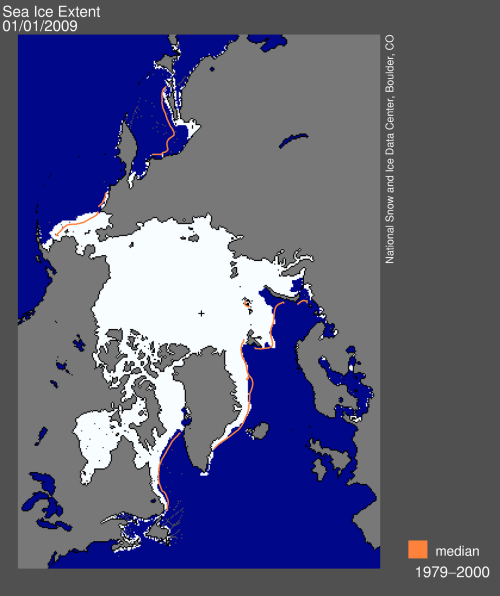
As you can see from today’s NSIDC graph (there’s always at least a one-day lag in the graph) the 2008-2009 refreeze rate has dropped to and continued at the same level as the 2007-2008 rate for a couple of weeks now.This is well below the 1979-2000 average and is indicative of an overall warming trend.

If the trend line continues as is or drops below the 2007-2008 line we are likely to seem a very heavy melt season in spring-summer 2009. It is important to remember that the new ice is thin, being first year ice and will be very susceptible to melting. See this earlier post for more detail.

Below is the latest NSIDC image of sea-ice extent. The orange lines indicate average sea-ice extent for this day for the period 1979-2000. And remember these are measurements of sea ice extent, not volume. In fact this last year set a record for minimum sea-ice volume.

Last year (2008) was also interesting because Arctic sea-surface temperature were up to 7 degrees warmer than the average.

sea-ice-extent-image-january-1-2009

Image from National Snow and Ice Data Center

Most of the focus in the press is on Arctic Sea Ice, which is as it should be given it’s startlingly accelerated melt rate, but something interesting is going on in Antarctica as well. While Arctic sea ice has been melting, Antarctic sea ice has been increasing, albeit at a much slower rate than the Arctic decrease. Although, at first blow, this might look like supporting evidence for the denialist/delayer position it turns out that this increase is not unexpected and is even predicted by some of the climate models. The fact is that it is further disturbing evidence of the reality of Climaticide.

Sea ice climatologies: Arctic and Antarctic sea ice concentration climatology from 1979-2000, at the approximate seasonal maximum and minimum levels based on passive microwave satellite data. Image provided by National Snow and Ice Data Center, University of Colorado, Boulder.

It’s important to keep in mind that the Arctic and Antarctic are geographically dissimilar, so it’s not too surprising that their sea-ice situations would vary. The Arctic consists of a largely frozen ocean surrounded by such land masses as Canada, Alaska, and Russia. Its southern cousin, meanwhile, is almost the exact opposite—a land mass surrounded by ocean on all sides.

Because it’s semi-landlocked, and thus less buffeted by ocean currents and winds, the Arctic tends to have more moderate seasonal swings in sea ice coverage. While Arctic sea ice can persist for many years, much of Antarctica’s sea ice tends to form and disappear quickly—and somewhat unpredictably.

Satellite monitoring of Antarctica’s sea ice began in 1972, and for the first six years there was an alarming reduction in coverage every year. But to the bemusement of scientists, the trend began to reverse itself in 1978. Since then, the surface area covered by the continent’s sea ice has expanded by an average of 0.5 percent annually; however, it’s a matter of debate whether sea ice covers as much territory today as it once did in the early 1970s.

No one’s entirely sure what’s causing the expansion of sea ice in Antarctica, but the likeliest explanation is a disturbing one. According to a 2005 NASA-funded study, warmer temperatures have caused greater snowfall around the continent’s edges, where the open oceans provide plenty of raw material for precipitation. (Warmer air absorbs moisture more readily.) The weight of that excess snow pushes sheets of sea ice down into the water, causing more water to freeze.

The incremental expansion of Antarctica’s sea ice has coincided with some more troubling changes. Four of the continent’s largest glaciers (whose fates are largely unrelated to that of sea ice) are retreating rapidly, and researchers blame increases in ocean temperature. The diminishment of such massive glaciers means that, despite the slow creep forward of the continent’s sea ice, the total mass of all Antarctic ice—which includes inland ice—has experienced a marked decrease. And a continuation of that trend could lead to significant rises in global sea levels. Furthermore, snow is melting much farther inland than ever, as well as high up in the Transantarctic Mountains. [emphasis–JR]

As mentioned above, denialist/delayers who are specialists in cherry-picking the data and ignoring the complex cause-effect relationships between the earth’s atmosphere, hydrosphere, land areas and biota, try to use the increase in Antarctic sea ice as evidence that the world is cooling. They ignore the logical explanation posted above for Antarctic sea-ice increase while also ignoring the sharp rise in Arctic temperatures, the melting away of ice shelves in both the Arctic and Antarctic (the Wilkins ice shelf lost a big chunk in the Arctic Winter(!) and is now expected to collapse completely at any time)

By the way, it is interesting to note that the Antarctic sea-ice melt for this year is below last year’s trend line bringing it closer to the 1979-2000 average.

Image: National Snow and Ice Data Center

The apparent contradiction (apparent only if you are ignorant of the science) between Arctic and Antarctic sea ice behavior is used by denialists/delayers (DD’s) to create doubt about This supposed cooling [it isn’t happening], according to the denialists/delayers is the result of a decrease in solar radiation (since human beings have no significant influence on the planet’s climate).

DD’s frequently misinterpret scientific articles, whether out of ignorance or malice is not always clear, in order to support their anti-global-warming positions. This was the case recently with a peer-reviewed paper by Dr. Anja Eichler of the Paul Scherrer Institute and colleagues. The DD’s claimed that Dr. Eichler’s paper supported their claim that solar radiation was the chief forcing for climate change. Joe Romm of Climate Progress was so outraged by the DD’s claims that he conducted an email interview with Dr. Eichler to clarify the matter.

ROMM: Am I correct that your study was NOT saying human-caused emissions were NOT the major factor driving the temperature record in the past century?

EICHLER: Yes, this is correct. We did a strong differentiation between preindustrial (1250-1850) time and the last 150 years. In the preindustrial time we found a strong correlation between the solar activity proxy and our temperature, suggesting solar forcing as a main force for temperature change in this time. However, the correlation between the solar activity proxy and Altai temperature is NOT significant anymore for the last 150 years. In this time the increase in the CO2 concentrations is significantly correlated with our temperature.

ROMM: Am I correct that your final sentence [in the paper] was merely saying that your results suggest the Sun was responsible for under 50% of the warming since 1900, but you were NOT saying your results shows that the Sun was in fact responsible for half the warming.

EICHLER: This is also absolutely correct.

She added that “uncertainties of our data” do not allow it to be used to give an exact percentage for how much solar activity was responsible for the warming in the past century. Other recent studies have concluded that the Sun’s contribution to recent warming is “negligible.”[emphasis–Joe Romm]

So, in summary, everything is as expected: Arctic sea ice is shrinking, Antarctic sea ice is growing and denialist/delayers are continuing to distort and misinterpret the science.

Crossposted at Daily Kos

Posted by: patriotdaily | January 1, 2009

Eco Corruption Harms Wildlife

Government investigations found that officials responsible for protecting endangered species have violated the law, censored scientists and manipulated data to limit recovery of species facing extinction in order to protect financial interests of industries instead. Many oppose Bush’s rampant violations of our rule of law governing human rights and civil rights but say we should move on. But, the lack of any accountability has caused illegal conduct to be silently accepted and spread like a virus infecting most substantive issues, including the Endangered Species Act (ESA). We face a catastrophic loss of species globally, the inability to provide the beauty of sustained biodiversity for future generations as well as financial repercussions. Taxpayers will pay for the investigations and the “unnecessary expenditure of hundreds of thousands of dollars to re-issue decisions” as well as the expensive costs of litigation filed to compel the government to comply with the rule of law.

After an employee alleged “political influence” at the Interior Dept., which is responsible for implementing ESA, 3 internal government investigations were conducted by the Office of Inspector General (OIG). The OIG report resulted in the resignations of several high-level officials, including Julie MacDonald, former Deputy Assistant Secretary of Interior, and officials who enabled or abetted MacDonald, including a former Assistant Secretary for the US Fish and Wildlife Service (FWS), a Special Assistant and an attorney from the Office of the Solicitor. The investigation reports painted a picture of government officials who used our employees as if they worked for private corporations. This resulted in ill-gotten financial gain for MacDonald and private corporations at taxpayer expense as well as “countless land-use decisions and developments that would have never otherwise been considered.”

Government officials interfered with science and manipulated data to implement an unwritten policy to exclude as much land as possible from critical habitat designations, which is the best tool for recovery of species after being listed under ESA. Species provided critical habitat are ”twice as likely to recover as species that do not have critical habitat designated.”

A variety of methods were used to eliminate or reduce protections for endangered species:

The internal investigation determined that MacDonald had censored scientific reports and overruled scientific findings which supported measures to protect endangered species. MacDonald reshaped the scientific reports despite the fact that she has a civil engineering degree and no formal educational background in natural sciences, such as biology. The OIG report found that MacDonald “bullied, insulted, and harassed the professional staff” to “change documents and alter biological reporting” on endangered species. Even a federal district court “accused MacDonald of intimidating agency staff.” Things became so bad that some government scientists gave up and started “Julie-proofing” or anticipating “what might be approved and wrote their decisions accordingly.”

Sometimes science was overruled to prevent ESA protection due to climate change impacts now harming wildlife, like the wolverines. The Bush team did not like that it was forced to list the polar bear as threatened due to climate change. Even though Bush’s new rules to ban consideration of global warming impacts is not yet effective, the Bush team did not want another case of ESA protection based on climate change. Given that the wolverines are not as popular as the polar bears, they may succeed. Never mind that the wolverines survive in deep snow needed to birth and raise their young or that the current declining snowpack in the western mountains will only worsen in the future. In order to prevent the listing of wolverines, DC officials overruled government biologists, who had determined that the wolverines qualified for ESA protections.

If science did not support MacDonald’s personal political agenda, she directed the government scientists to disregard scientific studies or to use a minority scientific opinion when it supported delisting a species. MacDonald also established informal policies that determined the role of science in ESA decisions. For example, if a petition opposed listing a species, then staff could use external data, but if a petition supported listing a species, then staff was limited to information contained in a petition.

The internal investigation revealed another informal policy by MacDonald of changing the rules when needed to protect corporate interests. MacDonald pressured staff to undermine the case for protection of the California tiger salamander by having staff count 3 sub-species as one. The result was that the government decided to cut critical habitat in half because it would be “too costly to restrict development in those areas to protect the threatened amphibian,” a decision applauded by home builders and developers. The government excluded all critical habitat acreage in one county that the scientists determined were “essential” to the recovery of the salamander.

Officials that were not biologists or economists replaced scientific findings and conducted economic impact analysis of critical habitat to restrict critical habitat designations. One final decision reduced the number of streams designated as critical habitat for the endangered bull trout fish in such an erroneous manner that a government expert responded that he could not defend the rule in court. In one case, MacDonald’s economic impact analysis was based on “math errors” of such “magnitude” in order to exclude critical habitat from a rule published in the Federal Register. The government then had to spend $100,000 to republish a corrected rule for this one manipulation.

The OIG investigation concluded that MacDonald violated federal law by sending internal agency documents to lobbyists, lawyers, and organizations that oppose ESA regulations on private land. For example, MacDonald provided these groups an internal draft of regulations for designating critical habitat; directed subordinates to obtain internal information on species for presentation to a lobbyist; forwarded an internal e-mail to an attorney, who used the e-mail as evidence in a lawsuit, and e-mailed large internal EPA files to chevrontexaco e-mail accounts.

MacDonald disclosed documents that even the public could not obtain under a FOIA request in order to obtain approval from the industry of a policy at the drafting stage:

On Feb. 4, 2004, MacDonald sent the Pacific Legal Foundation a 147-page document on Interior’s critical habitat policies. In an e-mail exchange with one of the foundation’s lawyers, MacDonald wrote: “I will send you a copy of the draft but please do not share it with anyone else. It’s still undergoing revision, although the fundamental legal/policy approach will not change. Does that work for you?

In one case, MacDonald provided private insider information to help the farmers who had sued the government, claiming the smelt fish no longer needed ESA protection. The government settled the lawsuit by agreeing to determine if protections were still needed. A government biologist did a scientific review, concluding the fish should remain protected. MacDonald then “fired off a blistering e-mail” to the biologist, “arguing that he and other biologists had oversimplified, according to documents unearthed during litigation.” Then, MacDonald provided her self-serving e-mail to the opposing lawyer, who gratefully appreciated her assistance by filing “a motion to reopen its case seeking to exempt the smelt from ESA protections, citing MacDonald’s e-mail as evidence the government’s science was flawed.”

In the case of our California Red-Legged frog, infamous from Mark Twain’s story of “The Celebrated Jumping Frog of Calaveras County,” our government used a closed-door settlement to reduce critical habitat in order to pave the way for development interests: The government scientists’ proposed critical habitat of 4.1 million acres was decreased to 450,288 acres. After the investigation, the FWS was forced to review this decision, and now proposes to quadruple the critical habitat to over 1.8 million acres.

The Inspector General also reported one incidence of conflict of interest: MacDonald succeeded in getting the FWS to remove from protected ESA status the threatened Sacramento Splittail fish. Remarkably, this fish “appears to be the only fish — other than those that have gone extinct — ever removed from the list of threatened and endangered species.” MacDonald “edited” agency documents to “soften” the scientists’ conclusion that the species was declining in population. Coincidentally, she stood to gain financially from this delisting as its habitat occupies her farm, thus delisting removes economic costs flowing from regulation.

MacDonald reviewed more than 200 ESA decisions, but the government initially determined that only 8 decisions or less than 4% would need to be revised due to her “political influence.” The 3rd investigation reviewed 20 more decisions, finding her influence potentially jeopardized 13. But what about all the Julie-proofed decisions where government scientists censored their work in order to get it approved by her?

Even without our current financial crisis, why should we pay twice for the same work that was screwed up by undue political influence? After an official abuses their powers and violates the law, why is resignation alone sufficient? Why not impose financial restitution so that taxpayers are not billed twice and so that we have the money to protect wildlife.

“The Amazon gives the breath of life to humanity.”. “That’s why this is the trial of the world.”

Ecuadoran Superior Court Judge Juan Nunez

On this site we have often talked about the health and environmental costs of mining, drilling for, and consuming fossil fuels. Whether it be the blowing up of mountaintops in West Virginia and Kentucky, the irresponsible and poorly regulated destruction involved in the mining of tar sands in Alberta or leakage from unregulated and negligently maintained fly-ash storage ponds in Tennessee, we are surrounded by examples of businesses run by men and women (but mostly men) who have been taught that their only responsibility is to maximize shareholder profits (for the doing of which they are allowed to award themselves bonuses equal to the GDP of some countries). Why were they taught this? And why do we accept it as normal?

Corporations and Morality

The idea that corporations are exempt from conventional morality is an odd one, one that we accept, I believe, largely out of inertia., because when one analyzes it, it makes no sense. Why should the most powerful among us have as their single standard of morality that they must satisfy their greed? Moral rules ought to be drilled relentlessly into the minds of people who work in corporations. Instead most of them are taught that pursuing one’s self-interest should be their only guiding principle.

It was a mistake to ever grant personal legal status to corporations and one of the first things that I would do if I had the power would be to abolish corporations as presently constituted. Large corporations such as ExxonMobil, Chevron, Southern Company, ADM, Monsanto, Dow Chemical, etc. simply have too much wealth and hence too many possibilities to corrupt government and manipulate and deceive the citizenry (consumers, not citizens, is what the corporations call us) about their actions and policies. They and the people who run them ought to be more closely regulated and scrutinized and held to account then any other entities in society.

In reality we spend far more money and time monitoring the actions of drug peddlers than we do these multi-billion dollar businesses who poison our water, soil and air, giving untold numbers of us cancer and other horrible illnesses. And that doesn’t even include their greenhouse gas emissions, which, via global warming threaten our civilization and ecosystems planet wide.

It ought to be a basic regulatory principle that the richer and more powerful an entity to be regulated is, the stricter, more vigorous and more transparent the regulatory and oversight process ought to be. Why? One of the reasons that the war against drugs fails is because drug lords have so much money that they can corrupt the police, the judges, and the bureaucrats charged with eliminating them.

Oil, coal and gas companies do the same, yet we are more concerned about regulating illegal immigration than illegal manufacturing, natural resource exploitatin, farming or finance. Think of large scale-businesses as being on a moral continuum with the worlds assorted mafia’s at one extreme and the world’s huge corporations only a step or two closer to the center, but still far out on the immoral edge.

The only thing that distinguishes many corporations from mafias is that mafias engage in activities that are considered wrong in and of themselves. Large corporations engage in what society generally sees as legitimate activities, but then use the same sort of immoral tactics as mafias to enhance their power and influence. Because corporations are engaged in what are generally seen as more legitimate enterprises, they hire more lobbyists than hit men, but their goals are the same as any drug mafia: to accumulate as much wealth as possible and to intimidate or corrupt any opposition to their activities. One of the principle differences between mafias and many large corporations is the people who run mafias know they are criminals while the people who run corporations tell themselves that they are society’s benefactors without whom the rest of us would be living in caves. But they both bribe congressmen.

The Case of Nueva Loja, Ecuador

As I wrote above, anyone who follows the news knows that there was a huge, poisonous, coal-sludge spill in Tennessee in the last few days. Fewer people know about how mountain-top removal violates people’s rights and threaten their lives or how mining for oil in Alberta’s tar sands makes a major contribution to Climaticide, destroys forests and wildlife and threatens rivers, lakes and aquifers.

Even fewer people know about the human and environmental catastrophe that Texaco (now part of Chevron) caused in Ecuador or about how the corporate world might be rocked if a court decision there is decided in the plaintiffs’ favor. Ecuador, probably because of it’s long victimization by large corporations, recently adopted a new constitution that grants legal standing to the environment.

Now Bloomberg is reporting in an excellent, long and detailed article, that I cannot recommend too highly, that Chevron may be fined up to 27 billion dollars if it loses a lawsuit filed by victims of Texaco’s (Chevron now owns Texaco–just part of the process by which large, powerful uncontrollable corporations become larger, more powerful and more uncontrollable) decades-long, ruthless exploitation of Ecuadoran oil fields without regard for the people or the environment.

Bolivar Cevallos walks around the farm where his family once lived amid the oil fields of Ecuador’s Amazon rain forest. His boots sink ankle deep in tar. Everywhere he steps, oily muck seeps from the ground.

A gasolinelike smell hangs in the sweltering jungle air. The mess is a remnant of oil drilling in a 120-mile-long swath of the tropical jungle in northeastern Ecuador where Texaco Inc. and Ecuador’s state-run oil company, PetroEcuador, have pumped billions of barrels of crude from the ground during the past 40 years.

Cevallos, 51, whose face is tanned and creased from a life working in the tropical sun, plunges a shovel into a ditch. Grease oozes out and drains into a river his family used for drinking and bathing for more than 25 years.

About 230,000 people live in Ecuador’s northeastern rain forest side by side with oil wells and pools of drilling waste. Cevallos is no longer one of them.

Four years ago, a doctor diagnosed his daughter, Diana, with histiocytosis X, a rare blood disease that caused tumors that punched holes in her skull.

“The doctor told us to get out because the pollution would make her sicker, maybe kill her,” says Cevallos, who used to tend patches of cacao on his farm and now works as a laborer on a construction site for $6 a day. His daughter, now 5, is thin and still ailing.

Map of Ecuador. Nueva Loja in the NE is where Judge Juan Nuñez will decide the case.

The story continues:

The ruined land around Cevallos’s home is part of one of the worst environmental and human health disasters in the Amazon basin, which stretches across nine countries and, at 1.9 billion acres (800 million hectares), is about the size of Australia.

And depending on how an Ecuadorean judge rules in a lawsuit over the pollution, it may become the costliest corporate ecological catastrophe in world history.

If the judge follows the recommendation of a court- appointed panel of experts, he could order Chevron Corp., which now owns Texaco, to pay as much as $27 billion in damages.

The case, which has languished for 15 years in U.S. and Ecuadorean courts, highlights the growing human and environmental toll of the global quest for oil.

Another problem in trying to regulate powerful corporations is that they have the resources to draw out for years any legal challenge to their crimes. Often their opponents do not have the resources to continue the fight and give up. In this case, the plaintiffs have the advantage of having support from the Ecuadoran government.

Now alow me to present you with some quotes from Chevron spokespeople in the company’s defense. I have provided context for the quote when I thought it necessary. I recommend very strongly that you read the entire article. [All emphases in the quotes below are mine–JR]

Chevron says Texaco had completely cleaned up its mess by 1998. PetroEcuador, which took over Texaco’s operations in 1990 — and not Texaco — is to blame for today’s pollution, Chevron says.

[Silvia Garrigo, Chevron’s lead in-house attorney in the case.] says residents have wrongly accused Texaco of contaminating the environment and that there’s no credible evidence linking diseases to Texaco’s work.

They have been told so many times that it’s Texaco, so everything that goes wrong in their lives, if their cow dies, it’s Texaco,” Garrigo, 47, says. “If their wife has diabetes, it’s Texaco.”

Health problems among residents of the Amazon are linked to poor sanitation and poverty, and residents of the oil region are pawns of activists and greedy attorneys, Garrigo says.

“You have people that are very needy,” she says. “They will lie. ‘My baby will have medical care, my son will get a job, if I testify.’”

Garrigo, Chevron’s lawyer, says the controller’s audit is a sham. It’s part of an Ecuadorean government campaign to concoct a case against the company and help the jungle residents and their lawyers reap billions of dollars of damages, she says.

“We have independent scientific analysis that refutes those findings,” Garrigo says.

Chevron spokesman Kent Robertson says there’s no scientific evidence linking Diana’s disease to crude oil.

Ana [a young girl who died of leukemia] probably came down with the deadly disease because of the oil pollution around her home, [Dr. Juan Sghirla, a hematologist at the Red Cross Hospital in Quito] says. Ana, whose family settled the farm before she was born, grew up about 100 yards from an oil well and drank from a shallow water well that lay underneath rusty crude-oil pipelines.

A team from the general controller’s office that took soil tests at a well near Ana’s home found hydrocarbon contamination 5,716 times normal levels, the 2003 audit says.

Once, when neighbors tried to dig a water well a few feet away, they struck a layer of tar, says Suquisupa, 50, who makes a living tending a patch of cacao and coffee on her farm. Ana’s family isn’t among those who sued Chevron.

Chevron spokesman Robertson says soil and water tests found no chemicals known to cause leukemia.

Chevron’s Robertson says the chemicals pose little or no threat to health. Ecuador’s Amazon gets an average of 120 inches of rain a year, and Texaco’s pits sometimes overflowed, polluting streams, according to the 2003 general controller’s audit.

In 2007, Judge Germn Yanez, the case’s third judge, appointed Richard Cabrera, a geological engineer in Quito with 20 years of experience, to evaluate the pollution data, assess the effects of contamination on people and the environment and recommend a cleanup plan.

Cabrera had specialized in environmental studies for mining and oil companies in Ecuador, and he put together a team of scientists, doctors and biologists.

In April 2008, Cabrera’s team concluded that Texaco’s mishandling of waste until 1990 was the main cause of the pollution. It proposed a cleanup of 916 pits and underground aquifers. The report pegged total damages at $16 billion.

The team reviewed studies by San Sebastian, the Spanish doctor, and a group of government health workers. It found that cancer rates were above those of areas of Ecuador without oil operations. Its revised report, which used studies by the American Petroleum Institute and the U.S. court cases to gauge costs, increased the damage estimate to $27 billion.

Chevron says the expert panel’s findings aren’t supported by the evidence. The company hired doctors, epidemiologists and other experts who refute the report.

Have you noticed how many of these statements are similar to the lies and disinformation offered up by TVA after the Kingston spill? Particularly, the part about toxic substances not being toxic. You would think that all these companies were running organic farms or manufacturing paper cranes to hear them talk.

The Chevron case is the most important environmental litigation on the planet, says Mike Brune, executive director of the San Francisco-based Rainforest Action Network, which lobbies companies to improve their practices.

“When the verdict comes in, it will force environmental ethics to go global,” he says.

It might be worth remembering all this the next time you see a Chevron ad about clean energy.

Posted by: JohnnyRook | January 1, 2009

New Form of Cement May Be a Carbon Sink

According to the Guardian, the London company Novacem has developed a new type of cement that is carbon negative (absorbs more carbon than it emits). If true, this would be a major breakthrough as cement currently accounts for 5% of the world’s CO2 emissions.

CO2 is released during cement production in two ways. First, generating the high heat needed to make the cement releases CO2. Second, the burning of the limestone releases even more. The new cement can be produced at lower temperatures, reducing energy consumption and CO2 emissions, plus as it hardens it absorbs more CO2 than conventional cement.

The Guardian explains:

Standard cement, also known as Portland cement, is made by heating limestone or clay to around 1,500C. The processing of the ingredients releases 0.8 tonnes of CO2 per tonne of cement. When it is eventually mixed with water for use in a building, each tonne of cement can absorb up to 0.4 tonnes of CO2, but that still leaves an overall carbon footprint per tonne of 0.4 tonnes.

Novacem’s cement, which has a patent pending on it, uses magnesium silicates which emit no CO2 when hearted. Its production process also runs at much lower temperatures – around 650C. This leads to total CO2 emissions of up to 0.5 tonnes of CO2 per tonne of cement produced. But the Novacem cement formula absorb far more CO2 as it hardens – about 1.1 tonnes. So the overall carbon footprint is negative – ie the cement removes 0.6 tonnes of CO2 per tonne used.

If the energy to make the cement comes from sustainable sources the amount of CO2 removed from the atmosphere could be even greater.

The project is being supported by the British government whose Technology Strategy Board has invested £272,000 in it.

Supposing that the claims made for Novacem’s cement hold up, it could play an important role in cutting greenhouse gas emissions given that demand for cement (like that of nearly every other industrial material as governments do not seem to be able to imagine an end to economic growth) is forecast to increase. In any case, it will take several years to get the new cement to market as first it must be tested for strength and licensed.

The new cement, which uses a different raw material, certainly has a vast potential market. Making the 2bn tonnes of cement used globally every year pumps out 5% of the world’s CO2 emissions – more than the entire aviation industry. And the long-term trends are upwards: a recent report by the French bank Credit Agricole estimated that, by 2020, demand for cement will increase by 50% compared to today.

Posted by: JohnnyRook | December 31, 2008

UK Met Office Predicts Warm 2009, Record Temperatures after 2010

After declaring 2008 the 10th warmest year on record (despite the strong la Niña that marked the year), the UK Met Office is predicting that 2009 will be one of the 5 warmest years ever. Full text of the Met Office’s press release follows:

2009 is expected to be one of the top-five warmest years on record, despite continued cooling of huge areas of the tropical Pacific Ocean, a phenomenon known as La Niña.

According to climate scientists at the Met Office and the University of East Anglia the global temperature is forecast to be more than 0.4 °C above the long-term average. This would make 2009 warmer than the year just gone and the warmest since 2005.

During La Niña, cold waters rise to the surface to cool the ocean and land surface temperatures. The 2009 forecast includes an updated decadal forecast using a Met Office climate model. This indicates a rapid return of global temperature to the long-term warming trend, with an increasing probability of record temperatures after 2009.

Professor Chris Folland from the Met Office Hadley Centre said: “Phenomena such as El Niño and La Niña have a significant influence on global surface temperature. Warmer conditions in 2009 are expected because the strong cooling influence of the recent powerful La Niña has given way to a weaker La Niña. Further warming to record levels is likely once a moderate El Niño develops.

[Here’s something the denialist/delayers never get (or at least will never acknowledge.]

These cyclical influences can mask underlying warming trends as Professor Phil Jones, Director of the Climatic Research Unit, University of East Anglia, explains: “The fact that 2009, like 2008, will not break records does not mean that global warming has gone away. What matters is the underlying rate of warming – the period 2001-2007, with an average of 14.44 °C, was 0.21 °C warmer than corresponding values for the period 1991-2000.”

2008 global temperature

Notes

* The Met Office Hadley Centre advises the UK government on climate change research. Its work is, in part, jointly funded by Defra (Department for Environment, Food and Rural Affairs); DECC (Dept for Energy and Climate Change and MoD (Ministry of Defence).
* The Met Office, in collaboration with the University of East Anglia, maintains a global temperature record which is used in the reports of the Intergovernmental Panel on Climate Change.
* Each January the Met Office, in conjunction with the University of East Anglia, issues a forecast of the global surface temperature for the coming year. The forecast takes into account known contributing factors, such as El Niño and La Niña, increasing greenhouse gas concentrations, the cooling influences of industrial aerosol particles, solar effects and natural variations of the oceans.
* The 1961-90 global average mean temperature is 14.0 °C.
* Global temperature for 2009 is expected to be 14.44 °C, the warmest since 2005, when the value was 14.48 °C.
* The warmest year on record is 1998, which was 14.52 °C, a year dominated by an extreme El Niño.
* Over the nine years, 2000-2008, since the Met Office has issued forecasts of annual global temperature the mean value of the forecast error is 0.06 °C.
* The first Met Office decadal forecast to 2014 was issued in 2007.
* Interannual variations of global surface temperature are strongly affected by the warming influences of El Niño and the cooling influences of La Niña in the Pacific Ocean. 2008, with a provisionally observed temperature of 14.31 °C compared with the forecast value of 14.37 °C. [all emphases–JR]

In April of this year, 500 ducks were found dead in one of Syncrude Canada’s tailings ponds. The Alberta provincial government is still trying to decide whether to file charges against the company. Complicated matter like this take time, don’t you know?

The Dead Duck Incident occurred only a few days after the Alberta Provincial Government, which is in the hands of the Conservatives, (Alberta is Canada’s Texas) announced that it would undertake a multimillion dollar PR campaign “to boost the province’s ‘brand’ in the face of criticism of the environmental toll of the oilsands.” Oil sands is what the oil companies have taken to calling tar sands in an attempt to make them sound more appealing.

[The] $25 million campaign to “brand” Alberta as a province that cares about the environment has been labelled a “greenwash” by critics, and aboriginal groups living downstream from the oilsands continue to raise concerns — and court challenges — based on their belief that oilsands discharge has polluted the Athabasca River, and is poisoning their fish and their people.

The term “dirty oil” has become a label that sticks.

Are dirty tar sands really that much different from dirty coal? The recent disaster in Tennessee where a leak from a pond holding toxic sludge from a TVA coal-fired power plant released 1.7 million cubic yards of fly-ash containing sludge, destroying 15 homes and covering 400 acres up to a height of 4-6 feet should remind Albertans of the dangers posed by these poorly regulated toxic holding ponds. It should also remind them of the dangers of regulatory agencies more interested in serving the the people they are supposed to be regulating, rather than the public at large.

Canadian regulatory agencies, at least in the hands of conservatives, seem to be as derelict in their duty as their American counterparts.

Early in the year, a report from the Environmental Defence Organization — titled Canada’s Toxic Tarsands: The Most Destructive Project on Earth — accused the federal government of being “missing in action” by failing to enforce federal laws to clean up oil extraction from the oilsands in Alberta.

In February, as Stelmach campaigned in the provincial election, he was confronted by the protester concerned oilsands projects are poisoning the Mikisew Cree. People living in the area around Fort Chipewyan believe their health is being adversely affected by oilsands development, causing a cluster of rare cancers.

Currently 9% of US oil imports come from Canadian tarsands. This despite the fact that oil made from tarsands produces 52% more CO2 emissions, from field to tank than does standard petroleum from Saudi Arabia.

Canadian development of tarsands is stupid, immoral and short-sighted. The US shares the culpability for importing petroleum produced in this fashion. Tarsands, like coal, pose specific threats to the people who live near the places where they are mined (or consumed in the case of coal) and a general threat to us all as they are the dirtiest forms of fossil fuels as regards greenhouse gas emissions.

It is high time to stop using fossil fuels. This year we lost 500 ducks in Alberta and 15 homes in Tennessee from localized pollution that still threatens others because government agencies refuse to enforce the law. How many more people died from the less direct effects of Climaticide? How many more will die in 2009? Far too many if governments continue to kowtow to oil and coal companies and utilities who for the sake of profits are willing to put other peoples lives at risk, be it from leaking toxic tailing ponds or CO2 emissions.

Also check out this fine post by David Sassoon at Solve Climate.

Science News is reporting on another climate related study [original article here-subs required] from the American Geophysical Union meeting in San Francisco:

In a presentation today to the fall meeting of the American Geophysical Union in San Francisco, JPL Senior Research Scientist Hartmut Aumann outlined the results of a study based on five years of data from the Atmospheric Infrared Sounder (AIRS) instrument on NASA’s Aqua spacecraft. The AIRS data were used to observe certain types of tropical clouds [Deep Convective Clouds (DCC)–JR] linked with severe storms, torrential rain and hail. The instrument typically detects about 6,000 of these clouds each day. Aumann and his team found a strong correlation between the frequency of these clouds and seasonal variations in the average sea surface temperature of the tropical oceans.

For every degree Centigrade (1.8 degrees Fahrenheit) increase in average ocean surface temperature, the team observed a 45-percent increase in the frequency of the very high clouds. At the present rate of global warming of 0.13 degrees Celsius (0.23 degrees Fahrenheit) per decade, the team inferred the frequency of these storms can be expected to increase by six percent per decade. [emphasis–JR]

Aumann said the results of his study, published recently in Geophysical Research Letters, are consistent with another NASA-funded study by Frank Wentz and colleagues in 2005. That study found an increase in the global rain rate of 1.5 percent per decade over 18 years, a value that is about five times higher than the value estimated by climate models that were used in the 2007 report of the Intergovernmental Panel on Climate Change. [emphasis–JR]

It has become clear that the latest IPCC report has underestimated the rate of climate change, which means that people who cite the report as justification for their policy decisions are probably proposing inadequate solutions to the problem of Climaticide. It is vitally important that government leaders get the latest information so that they can develop and implement policies that are actually strong enough to deal with the crisis.


Tropical Storm Ophelia, September 2005

Crossposted at Daily Kos

Everybody who is paying attention knows that Climaticide is the most pressing problem that we face. They also know that in order to avoid climate catastrophe we have to find a way to ween ourselves from our dependence on fossil fuels. Unfortunately, that is about as far as the consensus goes.

When it comes to deciding how we will replace fossil fuels and with what, the disagreements are serious and the debates passionate and, all too often, vitriolic. We meet proponents of wind (onshore and offshore), of solar (and its various subcategories), of nuclear (and its various subcategories), of geothermal, of wave, of carbon capture and storage for coal, etc.

How is one to reconcile all these various claims? Well, David MacKay’s new book, is a good place to start.

Unsettlingly, usually, these discussions involve more strong opinions than data. Some people believe that one of these alternative (they are not all sustainable) energy options is the silver bullet that will solve both the climate and the energy crisis. Other argue that there is no silver bullet and that what is required are a variety of silver BB’s: a mixture of technologies, along with greater energy efficiency and preservation of habitat (forests). Do we really just need to build huge number of nuclear plants or wind farms to solve the problem? If, instead, we are going to use a mix of alternative energy sources, which ones should we use and in what quantities?

Rarely does anyone attempt to answer these questions, which is why Cambridge University physicist, David JC MacKay’s new book: Sustainable Energy–Without the Hot Air is so welcome. Although MacKay’s focus is principally on the UK, (the book does have two short section in which he suggests energy plans for the United States and for the world as a whole) the principles and techniques he describes are applicable anywhere. The book will not be published in the US until April, but a PDF version is available for free download here.

Sustainable Energy–Without the Hot Air, is not a book about global warming. MacKay only briefly discusses the climate crisis in his first chapter, Motivations. His purpose, rather, is to bring the discussion about whether it is possible to create a viable non-fossil fuel economy down to earth by actually doing the calculations, albeit in rough, general terms, both from the demand and supply side. The result is very enlightening indeed.

MacKay explains that he wrote the book because:

I’m concerned about cutting UK emissions of twaddle – twaddle about sustainable energy. Everyone says getting off fossil fuels is important, and we’re all encouraged to “make a difference,” but many of the things that allegedly make a difference don’t add up.

Twaddle emissions are high at the moment because people get emotional (for example about wind farms or nuclear power) and no-one talks about numbers. Or if they do mention numbers, they select them to sound big, to make an impression, and to score points in arguments, rather than to aid thoughtful discussion.

This is a straight-talking book about the numbers. The aim is to guide the reader around the claptrap

I cannot praise this book too highly. Everyone who is interested in Climaticide and sustainable energy should own a copy. In easy to understand and, often, witty prose, MacKay leads the reader through an examination of all sorts of energy related questions. You can get a sense of the topics covered from the Table of Contents, which I have reproduced below.

As you can see the book is divided into four sections.

In Section 1 MacKay alternates calculations of UK energy use with calculations of energy production from various sustainable sources in an attempt to see if it would be possible to live on renewables alone. He illustrates this graphically by creating two stacks of boxes.

One stack contains boxes with values in kWh/d (kilowatt hours/day–a term he clearly explains in an early chapter) for the ways the British consume energy (transport, heating, etc.). The other stack contains boxes with values in kWh/d for the potential sources of renewable energy in the UK (wind, solar, wave, etc.) As he stacks the boxes one gets a visual impression of whether it will be possible to meet UK energy needs solely with renewables.

In Section II, he considers factors other than renewable energy sources that need to be considered as we decide how we can end our use of fossil fuels. These include, but are not limited to, energy efficiency, electrification of transport, nuclear power and the importation of renewable energy (principally solar) from other countries.

Section III is composed of technical chapters where MacKay explains in greater detail the various physics formulas and calculations that he has used to draw his conclusions. Although this is the section with the most math, MacKay claims that it should be intelligible to anyone with a solid high school background in science and math. I should add that it is not necessary to read Section III in order to understand MacKay’s arguments in the rest of the book.

Finally, Section IV contains useful quick reference tools, such as explanation of units, conversion charts, GHG emissions by country, etc.

MacKay is not preachy. He does not presume to tell us which plan to adopt in order to get off fossil fuels. In the book he presents a number of plans, which the reader is free to adopt, reject or modify as he chooses. What he does insist on though is that any plan be realistic, that the numbers add up. This insistence on constant reality checks may dampen the spirits of some, but I found it invigorating. I have known and written for quite a while now that the solutions to our Climaticide problem were going to have to be big. After reading MacKay’s book I now have a much clearer idea of just how big and why.

Near the end of Section I MacKay draws an important conclusion from the calculations he has made in the previous chapters.

For any renewable facility to make a contribution comparable to our current consumption, it has to be country-sized. To get a big contribution from wind, we used wind farms with the area of Wales. To get a big contribution from solar photovoltaics, we required half the area of Wales. To get a big contribution from waves, we imagined wave farms covering 500 km of coastline. To make energy crops with a big contribution, we took 75% of the whole country. p. 112

Sustainable Energy–Without All the Hot Air is a great book precisely because it is so sobering. If you read it, you may be forced to revise some of your opinions about renewable energy. But that is good. It will mean that you have a better grasp of the facts and of how truly monumental are the changes that we need to bring about.

Sustainable Energy–Without All the Hot Air is a great book precisely because it is so sobering. At first, you may feel disheartened because MacKay does not minimize the magnitude nor the difficulty of achieving the solutions necessary to stop Climaticide. Later, however, after you have got over the initial shock, I think you’ll find yourself encouraged, because MacKay’s hard-headed approach and his insistence on looking at the numbers show that, despite the difficulties, it is possible to create a world in which there is a sufficient supply of energy for everyone without the use of fossil fuels.

This book is full of useful facts and insightful analysis. It is written with panache and illustrates its many points with copious helpful images, graphs and charts. Download a copy and read it. You’ll be glad you did.

« Newer Posts - Older Posts »

Categories